After completing a month in power on Saturday, the newly-elected AAP government in Punjab fulfilled its first election promise of providing 300 units of free electricity every month to every household in the state from July 1.
The Chief Minister of Punjab said that SC, Backward Caste, BPL families and freedom fighters are currently getting 200 units free every month, now they will get 300 units of electricity every month, if their consumption is 600 units in two months. more than that, they will be charged only for more units.
The Chief Minister said that if the consumption of electricity in other households exceeds 600 units in two months, the consumer will have to pay for the entire electricity usage. He said that there would be no increase in electricity rates for industrial and commercial consumers, while free electricity to the farming community would continue.
The move comes after inputs from cash-strapped Punjab State Power Corporation Ltd (PSPCL) that it would be difficult to provide free electricity in the summer months. As first reported by ET in its April 14 edition, the state is grappling with a shortage of coal to keep its thermal power plants running and is barely able to meet the current demand. With the onset of paddy sowing season, the demand for electricity will increase further. The PSPCL had told top AAP officials that providing free power at this time would lead to indiscriminate use of electricity and demand could pick up in the crucial summer months.
AAP Convenor and Delhi Chief Minister Arvind Kejriwal welcomed the move and said, “AAP does what it says and does not make false promises like other parties. An honest and patriotic government with clear intentions has come to Punjab. We We will not allow shortage of money gets in the way of progress.”
Meanwhile, Punjab Congress chief Amarinder Singh Raja Warring hit out at Chief Minister Bhagwant Mann and questioned the move, citing the conditions attached to it. “The proof of Halwa is in the food… The truth of your 300 units of free electricity will be tested in its details and conditions. Best wishes to PSPCL, who have to survive somehow,” tweeted.
According to the roster they drew up, J Vinayaka’s firm expected him to turn up at office only in September. But the 25-year-old Android developer had no intention of waiting another six months to visit the workplace he had joined — virtually — a year ago. So, soon after his office in a Bengaluru tech park reopened its doors in April, Vinayaka was there, walking through a colourful arch that said, “Happy 2B Home, Together as One”, past a recreational area with balloons and foosball tables and posing at a photo booth with the company logo, holding up a sign saying #BestDayEver.
As far as rolling out the red carpet for employees returning to office (RTO) goes, this might pale before what tech titans like Google in the Bay Area are planning (a private concert by pop star Lizzo awaits, reports The New York Times) but Vinayaka was bowled over. “They gave me all these welcome goodies — a company mug, sweets, cosmos plant seeds. It was awesome,” says the engineering graduate. But despite the warm fuzzy feeling of being in office and his genuine joy at meeting and chatting up colleagues from his and other teams, the Andhra native will be heading back to his hometown of Kurnool and intends to work from there till September. When remote work ends, he hopes he can work from home (WFH) at least some days of the week. “I like the hybrid model, where you can come if you want to and not if you don’t,” he says.
Having spent one day a week at the NCR office of his Big Four firm since mid-March, associate Varun Singh (name changed on request) is not convinced of the utility of even the occasional visit. “For my team, there is no point being in office as our work can be done from anywhere. We are going solely for the optics because the leadership wants to project a certain image,” says Singh, 27. To add to his chagrin, all the pandemic hiring has led to a space crunch. “I don’t have my own desk,” he says. But what about the lunch-time camaraderie and water-cooler chats some wax eloquent about? For Singh, it’s not worth the effort of the commute. “Nor am I getting as much work done as I do from home.”
With the Omicron surge ebbing and the bulk of their workforce vaccinated, many companies are asking staff to return to office. But who all should come, when, how often and how to convince employees of the point of it all is a minefield companies here, like their peers across the world, are gingerly navigating.
While the last two years have busted the myth that productivity hinges on being in office, the management view in many firms is that physical presence is important to foster innovation and company culture, improve collaboration and create a sense of belonging after two years of WFH. All this, they hope, may also stem attrition, which, in certain sectors like IT, are at record levels. Human resources teams are thus working overtime to make an event out of the “first day in office”, managers have been given budgets to take teams out for meals and your LinkedIn feed is probably awash with shiny, happy “#BackToOffice” videos. Some firms have also reached out to counsellors to ease employees’ anxieties over the return, says Meeta Gangrade, COO of employee assistance firm 121help.net.
But conversations with employees, employers and experts in recruitment and organisational behaviour reveal that the incentive people prize above all else is the flexibility to choose when to go to office, which the pandemic unexpectedly bestowed on many white-collar staff for the first time. Even those enthusiastic about going to office are less so about doing so every single working day. As Debolina Dutta, professor of practice — organisational behaviour & HRM, IIM-Bangalore, puts it, “Now that they (employees) have tasted blood, they don’t want to give that up.”
Some Tread Softly, Others Less So
This desire for flexibility is not confined to Gen Z. Mansee Singhal, rewards consulting leader at Mercer India, saw this when she visited the premises of a client. Pre-pandemic, it was a large campus abuzz with activity. But now, not more than 15% of the leadership was coming in since it was voluntary, the HR team told her. “If anything, the younger employees seem keener to come to office, having missed the office vibe and conversations with friends at work,” says Singhal.
Gayatri Sathiyan would agree. The 23-year-old is in the midst of relocating from Mumbai to Bengaluru for her new job though the company offers hybrid and remote work options. As someone who graduated amidst the pandemic, she has mostly worked remotely till now and is looking forward to making friends at work and interacting with managers and the leadership. “I’ll definitely miss the convenience of remote working, where you are your own master when it comes to your time. And many don’t want to get out of the comfort zone they’ve got into over the last two years. But a lot of my peers are also eager to build connections in the real world right now and work from an office or a co-working space,” says Sathiyan.
The sense of control that flexible working hours give is an attraction for employees, agrees social psychologist Anna Chandy. “But some have also said they would like to go back to the office so there’s no mixing of professional and personal lives,” she says. The boundary setting is a perk Hena Mehta, cofounder of fintech startup Basis, is appreciating anew on Day 2 of the company’s trial of being in office two days a week, despite the traffic being “a time sink!” “An office helps you separate work from your personal life — it helps you focus better. I’m seeing that particularly as a new mom,” she says, while also adding that WFH had eased her transition back to work from maternity leave.
According to recruitment site Indeed, employees across categories are comfortable with some degree of flexibility, with the portal seeing a 17.5% increase in searches for remote/flexible work in October-March. Also, a survey by Indeed revealed there is a gender skew, with more women seeking opportunities that offer hybrid and remote work. “There is a strong preference among women for jobs that offer flexibility, with 60% of women job seekers looking at remote and hybrid work options, while for men, it’s 20%,” says Sashi Kumar, head of sales, Indeed India.
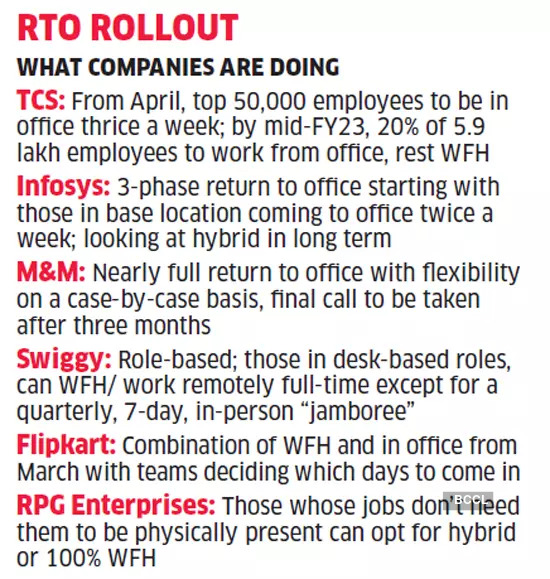
Companies large and small are in experiment mode. Some have set organisation-wide mandates to come in two or three days a week, while others are letting teams and managers thrash out the details. “Except those who need to be physically present like shop floor employees, all others are working hybrid or are on 100% WFH, if their role allows it,” says S Venkatesh, group president-HR, RPG Enterprises. FMCG major Marico has rolled out a hybrid work model which, according to CHRO Amit Prakash, “allows our members to shape their work around their lives. We have also outlined a case-by-case location flexibility option for remote work”.
IT behemoths Infosys and TCS are looking at continuing with the hybrid model. Accenture is setting up a presence in new locations like Jaipur and Coimbatore and has not set a universal date for employees to return to office. “When it comes to the future of work, we believe there is no one size fits all and our approach to how, when and where we work will vary by business, team and the type of work we do,” says Lakshmi C, MD and lead-HR, Accenture in India.
Food delivery unicorn Swiggy’s employee survey revealed that over 80% employees would like the flexibility of WFH. “One thing was clear: if we could trust employees for the last two years, why not continue that and make it flexible for them?” says Girish Menon, head-HR, Swiggy. Accordingly, employees have been put in role-based buckets, with those who work from a desk having the option to work from anywhere, provided they turn up every quarter for a 7-day, in-person “jamboree”. Ecommerce major Flipkart, which reopened its corporate office in phases, has adopted a hybrid model with teams having the discretion to decide details. “This model is a combination of employees working remotely and from the office on different days of the week, allowing teams to decide the days that work best for them,” says Chief People Officer Krishna Raghavan.
Naushad Forbes, cofounder of Forbes Marshall, was surprised to find employees coming to office most days when they piloted a mandatory one day a week in office. “I feel giving flexibility makes employees more productive,” he says. Pune-based engineering firm Thermax has adopted a role-based, hybrid work model. “We are not allowing permanent WFH as company culture gets impacted but we are also not mandating how many days employees spend in office as it will depend on the nature of work and what needs to be delivered. So our focus is on measuring outcomes instead of time in office,” says HR chief Jasmeet Bhatia, adding that not having a hybrid work environment is now considered outdated. At the Hyderabad office of US firm Solenis, employees come in two days a week, to be ramped up to three next month. “Employees don’t like perks being taken away. We have clarity that this model works so I don’t think we will go back to five days in office,” says vice-president Hitesh Chelawat.
And employees appreciate having autonomy and flexibility. Her firm’s hybrid work option allows 39-year-old Pali Tripathi, VP, fleet management solutions at RPG who became a mother recently, to work from home when she’s not out in the field. “Earlier, if we were not out meeting clients, we had to be in office. That’s no longer the case.” For newly-wed Pratik Singh, head, modern trade operations at Marico, the option to work remotely meant he could be in Hyderabad, his wife’s base, instead of having to look at relocation options. “It’s helped me have a healthy work-life balance without having to worry about career progression,” he says.
But these options are not across the board. All employees at Mahindra & Mahindra are back in office from April 1 with “flexibility being provided where needed” says group HR president Ruzbeh Irani. The policy, he says, will be reviewed in three months. On Thursday, chairman Anand Mahindra tweeted a video of employees back in office, adding, “Screens are no substitute for a warm personal hello.”
In sectors bled dry by a talent war, recruitment experts say remote and WFH options might well seal a hiring deal. Swiggy’s Menon affirms that the company’s policy is helping attract the category of talent that is interested in the brand and company, but less so in relocating.
“There’s a senior hire we are trying to get on board, who did not want to move to Bengaluru from Gurgaon. But once they read our work mandate, they became keen because now they know they need to come here only once a quarter,” he says.
Conversely, the lack of flexibility might drive out employees, who may initially toe the RTO full-time mandate but will leave as soon as they find a better option. A mid-management executive at a Mumbai-based conglomerate, for one, is fed up with the hassle of the daily commute his RTO involves. “I’ve applied for jobs at multiple firms,” he says, on the condition of anonymity.
As the RTO experiment rolls on, there will be new learnings. For one, companies will need to figure out how to maintain equity and fairness. “Those whose roles do not allow WFH might need to be compensated in some other way, not necessarily monetarily,” says IIM-B’s Dutta. There will also be the challenge of proximity bias. “A section of the workforce will come to office to show they are good organisational citizens, which might create pressure on others to follow suit.”
For now, flexibility is the key word. “I like hanging out with people and there’s a lot of learning that happens in person. But some people don’t, and that’s fine. It has nothing to do with productivity,” says Ajinkya Kulkarni, cofounder of Wint Wealth. The early-stage startup’s largely young 70-strong workforce can come to office or not, depending on their job profile but Kulkarni has noticed that people have been coming in voluntarily. “I think people are bored. And office main AC hota hai (office has AC)!”he chuckles. Kulkarni adds that the company is trying to keep things as flexible as possible. “Define targets, and as long as the work gets done, there is no need to look over anyone’s shoulder.”
As a nearly two-year, unprecedented WFH experiment comes to an end, questions abound. Some are existential, like what is the very point of an office if you can work equally efficiently from anywhere? Others less so, like what will my manager think if I come in once a week and my teammate thrice? Ironically, the one concern that’s not top-of-mind? “No one’s talking about Covid or health and safety. People assume the pandemic is over,” laughs 121help’s Gangrade.
Only a little over a year ago, the Europa Conference League was still just an idea. It didn’t even seem like a particularly good idea, really. Explaining where such a league would fit in the pecking order of the game, what its purpose would be, hardly constitutes a compelling elevator pitch. Europe already had two continental tournaments: the wildly popular Champions League and the widely tolerated Europa League.
Why not add a third, then – one that included all the teams that weren’t big enough to qualify for the other two competitions? Why not advertise this new tournament as a way to make European football more “inclusive”, a prize that is available to teams that have been out of major finals for decades? And sure there’s a single, angry representative involved from each of Western Europe’s powerhouse leagues? And how about a long, cumbersome and deeply unattractive name?
And yet, although the Conference League as a concept seemed nothing short of silly, the kind of notion that could only be created by a coercive and self-critical bureaucracy, we are fast approaching that point. Where we have to accept the impossible: this, as it turns out, is a good idea. Its games are competitive. Its stadiums are full, or close enough. The teams involved, even those who could have been expected to see this new league as a load, are sufficiently invested in the idea of winning it.
There has been at least one angry encounter in a tunnel, a sure sign of a contest with Meaning. Countries that have had little interest for years in the final stages of Europe’s showpiece tournaments have found themselves enjoying the best kind of football: winner-take-all in the spring. Even those fans, who initially saw the Conference League as a money-grab, a consolation prize and – worst of all – a wholly artificial creation. Value is not an innate thing.
The Champions League does not by divine right carry more weight than any other tournament. It is not always to be seen as the pinnacle of the game; It was also met with such considerable skepticism that the British were initially unwilling to grace it with their presence. Nor can importance be reliably measured in pounds, dollars and euros. The Champions League is not the most important tournament as it is the most lucrative; It is the most profitable because it is the most important. Someone — maybe SoftBank, if we’re being honest — could launch a more prosperous competition at any point, but not make it any more worthwhile. No, the value is not implied.
Rather it is implemented. It is a form of cultural convention, a tacit agreement between players and coaches and officials and, in particular, between fans: We determine which tournaments matter. The convention league illustrates that axiom perfectly. The tournament is important because the people involved have considered it important. So, conversely, so does the fate of the FA Cup. Anyone who has ever spoken with an English football fan of a particular vintage will know that there was a time when the FA Cup Final was the highlight of the season. To win the cup, the myth goes, is better than winning the league because the whole country watched the cup final.
The myth is, perhaps, a touch harsh. As recently as the mid-1990s, the day of the FA Cup Final was the centerpiece of the English football calendar. For years, it was the only sport to be broadcast regularly on television. It was a more widely accessible occasion, and therefore more memorable. Legendary or not, FA Cup status has waned over the past three decades. The cup no longer matters as much as it did before, not because the competition has changed – it hasn’t – but because the circumstances surrounding it have.
The creation of the Premier League made it necessary to declare the importance of that competition at the cost of almost everything else, and after some time, the hype was autocomplete. The natural order of football shaped itself around the league. The FA Cup became an afterthought. The Premier League also introduced football as a television product; The Cup will no longer be extraordinary just because it was aired. At the same time, the growing internationalism of the sport and the advent of the Champions League made Europe a priority and a rich prize for more teams than ever before.
The FA Cup lost a bit in mayhem. This is not to say that, from the point of view of 2022, the FA Cup doesn’t matter, or that it doesn’t produce drama, romance, intrigue or glory. Competition takes place on all fronts. But its value relative to the rest of the game has been eroded, both for those involved in the game and those who watch them. The meaning of a competition is not fixed. It can rise and fall depending on our tastes. Sport – the uneasy alliance of all who play and watch football and run and love it – decides what matters.
The Europa Conference League is a useful reminder. This could easily have failed, the craze of the major European leagues – which believe everyone wants the same teams to see each other playing in different combinations over and over again – proved contagious. It’s not just because it was a good idea, it’s flourishing. That’s because we accepted it was a good idea and because we decided it mattered.
parineeti chopra dating umar riaziActors Parineeti Chopra and Umar Riaz are the new love birds of B-town as per the social media buzz. the former bigg boss 15 Contestants and Indian Reality Shows skill According to a fan post on Twitter, the host was seen in a similar white T-shirt. Parineeti and Umar have not been exclusive about their dating life, so this is a new development among rumour-mongers. Check out his tweet by a fan of Umar:Also read- IPL 2022: CSK net bowler Salman Khan remembers MS Dhoni’s golden tips
Also Read – Lock Up: Ekta Kapoor, Tusshar Kapoor and Divya Aggarwal will celebrate with the prisoners!
Fans go crazy over Parineeti-Omar link-up rumour!
As Parineeti mostly likes to speak about her work projects, cover photoshoots and funny holiday posts during her interviews. The actor has kept his personal life under wraps as of now. Umar was earlier associated with TV Star and bigg boss 15 Contestant Rashmi Desai who recently did a cameo in Tejashwi Prakash starrer Naagin 6. As soon as a fan tweeted a picture of Parineeti and Umar in identical t-shirts, Twitter was flooded with different pictures of Umar and Parineeti wearing the same outfit on different occasions. Check out this tweet from a fan: Also Read – Lock Up: Poonam Pandey cried remembering her family after being evicted from the residential society, Karanvir consoled – watch
How can so much be the same
It’s not a coincidence, there is something between them.#umriaz#umarsena#upri
on the work front Parineeti Was recently seen as a judge on the reality show with Mithun Chakraborty and Karan Johar skill, The actor will next be seen on the silver screen in Sooraj Barjatya’s Uchhaan alongside Amitabh Bachchan, Anupam Kher, Boman Irani, Danny Denzongpa and Neena Gupta. related to YouthActor/model, a medical surgeon by profession can also enter reality shows lock up, the former bigg boss 15 According to a report in The Siasat Daily, the contestant will exit the show as the highest paid contestant.
Amid a spurt in COVID-19 cases in Lucknow, Ghaziabad and Gautam Buddh Nagar, the Uttar Pradesh government on Saturday put all National Capital Region (NCR) districts on alert mode, according to an official statement. The instructions to this effect were given by Chief Minister Yogi Adityanath while presiding over a meeting on COVID-19 management in the state, the statement said.
During the meeting, the Chief Minister said that in the last few days, there has been an increase in the cases of COVID-19 in the neighboring areas of the state and its impact can be seen in the NCR districts. He asked the officials to put all the districts of NCR on alert mode.
In view of the current situation, the entire NCR has been put on alert mode.
Adityanath also directed officials to send samples of COVID-19 patients for genome sequencing.
According to the statement, Gautam Buddh Nagar reported 70 COVID-19 cases on Saturday and 11 in Ghaziabad.
Adityanath asked officials to expedite the administration of booster doses of COVID-19 vaccines to all adults.
Booster dose is being administered at 700 private immunization centers of the state.
The chief minister asked the officials to be vigilant about malaria in Bareilly division and create awareness about prevention of dengue in Agra and Lucknow divisions, the statement said.
Apart from this, he said, according to the statement, awareness should be created among the people in Purvanchal (East Uttar Pradesh) about encephalitis.
A heat-stable COVID-19 vaccine that is being developed in India and does not require cold chain storage has generated strong antibody responses against coronavirus variants, including Delta and Omicron, according to a study on mice.
The vaccine candidate by the Indian Institute of Science (IISc) in Bengaluru and biotech start-up company Mynvax uses a part of the viral spike protein called the receptor-binding domain (RBD), which allows the virus to bind to the host . cell to infect it.
The team, including researchers from Australia’s Commonwealth Scientific and Industrial Research Organization (CSIRO), noted that most vaccines require refrigeration to remain effective. The heat-tolerant COVID-19 vaccine candidate can be stored at 37 °C for up to four weeks and at 100 °C for up to 90 minutes.
In comparison, the Oxford-AstraZeneca vaccine, known in India as Covishield, needs to be stored between 2-8°C and the Pfizer preventative requires special cold storage at minus 70°C.
The latest study, recently published in the journal Viruses, assessed vaccinated mice sera (blood samples) for efficacy against major coronavirus variants, including Delta and Omicron.
The study found that immunized mice with different formulations of the vaccine elicited high titres (unit for measuring quantity or concentration) of antibodies that could bind to the SARS-CoV-2 variant VIC31 (reference strain), the delta and omicron variants of the coronavirus. neutralize.
Compared to VIC31, there was an average 14.4-fold reduction in neutralization against the Omicron variant for one formulation of the Mynvax vaccine and a 16.5-fold reduction for the other formulation.
According to the researchers the respective values for the reduction in neutrality against the delta variant were 2.5 and 3.
“The average 14.4- or 16.5-fold reduction in neutralization against Omicron ba.1.1 for the monomeric and trimeric formulations, respectively, is consistent with similar reductions seen with the major COVID-19 vaccines,” the study authors said.
“Our findings suggest that the monomeric formulations are suitable for upcoming phase I human clinical trials and have the potential to increase efficacy with vaccine matching to improve responses against emerging forms,” they wrote in the journal.
Monomeric and trimeric formulations refer to the different shapes and combinations that can be used to develop a vaccine.
CSIRO’s evaluation of the various Mynvax formulations will aid in the selection of the most suitable candidate and dosage regimen for planned human clinical trials in India.
The vaccine’s heat tolerance and ability to withstand transient thermal shock are particularly promising to address vaccine inequality, which affects most low- and lower-middle-income countries, the researchers said.
Globally more than 10 billion doses of COVID-19 vaccines have been given and 51 countries have reached more than 70 percent of their population. However, it is only 11 per cent in low-income countries.
Activision Blizzard is cooperating with a federal investigation by friends of its chief executive into the business before the gaming company disclosed its sale to Microsoft Corp., it said in a securities filing Friday.
It received requests for information from the U.S. Securities and Exchange Commission and a subpoena from a Justice Department grand jury, the producers of “Call of Duty” said in an amended proxy filing.
The request “appears to be related to their respective investigations into trading by third parties – in securities prior to the announcement of the proposed transaction – involving persons known to the CEO of Activision Blizzard.”
Microsoft in January agreed to acquire Activision in the largest video-gaming industry deal in history for $95 per share, or $68.7 billion in total.
The company did not name the parties nor whether the grand jury summons was directed to an employee.
The filing was not disclosed upon receipt of a summons or SEC request for information.
Find stories that interest you
The Wall Street Journal reported last month that media moguls Barry Diller and David Geffen and investor Alexander von Furstenberg along with Activision CEO Bobby Kotick had acquired share options after von Furstenberg met with Activision CEO Bobby Kotick and some of them from disclosing the sale to Microsoft. day before.
“Activation Blizzard has informed these officers that it intends to fully cooperate with these investigations,” the company said.
Diller told Reuters last month that neither of the three had any information about a potential acquisition and had acted on the belief that Activision was undervalued and had the potential to go private or be acquired.
The amended proxy filing, which included information on its collaboration with the SEC and the DOJ, sued the company after shareholders alleged it missed the initial proxy on sale.
Stay on top of technology and startup news that matters. Subscribe to our daily newsletter for the latest and must-read tech news, delivered straight to your inbox.

 (@Naagin___)