Ruling parties in West Bengal, Maharashtra and Chhattisgarh won while the ruling NDA alliance in Bihar lost to the opposition RJD, as results for one Lok Sabha seat and four assembly seats in four states came out on Saturday.
Trinamool Congress won the Asansol Lok Sabha seat for the first time in its history, where its candidate film star Shatrughan Sinha defeated BJP’s Agnimitra Paul by a record margin of 300,383 votes.
The seat fell vacant after BJP MP Babul Supriyo resigned from the party and joined the Trinamool Congress.
Supriyo contested from Ballygunge assembly seat on Trinamool ticket and defeated CPI(M) candidate Saira Shah Haleem by 20,228 votes. BJP’s Kiya Ghosh came third.
West Bengal Chief Minister Mamata Banerjee said, “We have won the Asansol seat for the first time since the inception of our party. We have won with a record vote. I thank the people of Asansol for voting for us.” “I would urge the people of Bengal and my political allies to maintain peace and harmony. Despite the BJP’s conspiracy, people are trusting us.”
In the 2014 and 2019 Lok Sabha elections, BJP won the Asansol seat. Earlier the CPI(M) used to win there.
In Maharashtra, the Congress retained its Kolhapur North seat despite the BJP’s strong Hindutva campaign in the constituency. The bypoll was necessitated in December 2021 following the untimely death of Congress MLA Chandrakant Jadhav due to Covid-19. The Congress has fielded his wife Jayshree Jadhav as the candidate of the ruling Maha Vikas Aghadi (MVA) alliance. He defeated Satyajit Kadam of BJP by a margin of 18,800 votes.
In Chhattisgarh, Congress won the Khairagarh seat by defeating two-time MLA and BJP candidate Komal Jangel by 20,176 votes. In 2018, this seat was won by Devvrat Singh of Janata Congress Chhattisgarh from Ajit Jogi.
The ruling NDA alliance in Bihar lost the Bochahan seat to the RJD. The seat felt vacant after the death of sitting MLA Musafir Paswan, who represented the Vikassheel Insaan Party (VIP), which was then a part of the ruling coalition. BJP has fielded its own candidate Baby Kumari this time while ousting VIPs from NDA. RJD has fielded Amar Paswan, the son of Musafir Paswan. Paswan had won this seat by 36,653 votes.
Aspects related to the trade of Intellectual Property Rights (TRIPS) among member states of the World Trade Organization (WTO) define ‘Geographical Indicators’ (GIs) as ‘indications that indicate the origin of a good in the region of a good’. identify. [WTO] member, or a region or locality in the region where a given quality, reputation or other characteristic of the good is essentially attributable to its geographical origin.’ GI is used to endorse the value and brand of an item and protect it from copycats and thieves.
For example, in the Geographical Indications Registry of the Ministry of Commerce and Industry, Government of India, ‘Champagne’ is registered by the Comité Interprofessional du Vin de Champagne (CIVC), a group of wine producers, cooperatives and traders from the province of Champagne in northeastern France. represents a group. , According to the GI, all sparkling white wines sold in India under the description of ‘Champagne’ – whether Dom Pérignon or Taittinger – can only be from Champagne.
Similarly, after the Indian Patent Office registered ‘basmati’ in 2017 as a long-grain rice grown only in Punjab, Haryana, Himachal Pradesh, Uttarakhand, western Uttar Pradesh and Jammu and Kashmir, India has registered a protected GI Applied for the position in the European Union. Basmati in 2020. If and when registered by the European Union – which has been challenged by Pakistan – any other variety of rice sold as ‘basmati’ across the world would be illegal.
Very smartly, the GI Registry of India – after a very bitter fight between Odisha and West Bengal over the place of origin of Rasagola/Rasagola – in 2017 designated West Bengal to ‘Banglar Rasgulla’ and Odisha to ‘Odisha Rasgulla’ as the GI graded. In 2019, it left generic sweets free to be made and sold from Punjabi kitchens in Delhi’s Gol Market and elsewhere.
GI allows parties to claim credit for their products and protect them from interlopers. But a new form of Geographical Indication has emerged. Geographical areas are being ‘tagged’ by their perceived negative qualities and bad reputation.
Rudyard Kipling called late 19th-century Lahore the ‘city of dreadful nights’ – not Calcutta, as many self-racist Bengalis think – and more recently, Donald Trump called Haiti, El Salvador and African countries ‘shitholes’. ‘ Told. , bound by the racism of patent leather. But now we have Indians who indulge in GI-based misuse of territories within India.
For example, Mamata Banerjee, like many other gentlemen in her state, has GI-tagged Uttar Pradesh for rape. Rape is not credible in any other state like Bengal. Speaking at the inauguration ceremony of the state government’s trademark Biswa Bangla (Global Bengal) fair on Tuesday, the West Bengal CM had criticized the way the media covered the 14-year-old gangrape case in Nadia district – not Noida – on April 4. And dying the next day. One of the accused arrested five days later is the son of Trinamool Congress block president Samar Gola.
When Didi – remarkably ‘big sister’ in Bengali and Hindi – erupted in front of VIPs and audience: ‘Would you call this a ‘rape’? Or call it ‘pregnant’? Or call it ‘love affairs’ (sic)? I asked the police, ‘as if telling of an exchange between Hamlet and Polonius whether the cloud was shaped like a camel, or a mongoose, or a whale.
‘The incident is bad, the arrest has been made. But the boy apparently had a love affair with the girl, I heard… If a boy and a girl have an affair, I can’t stop it. It is not Uttar Pradesh that I am going to do ‘love jihad’. Saying this, Banerjee said such arrests “do not happen in Madhya Pradesh, Uttar Pradesh, Rajasthan or Delhi”. This happens only in Bengal.
Banerjee geographically identified the ‘Hindi heartland’ as a region where rapes are a dime a dozen, without any judicial or social consequences. This clearly GI-tagging is an administrative and cultural insult that no one else can claim.
The fact is that this week alone, two other cases of rape – a teenager found hanging from a tree in Bankura, and a 40-something woman in South 24 Parganas – were not recorded in Unnao or Hathras, but ‘over there’ was recorded. No one should be distracted by what Didi is saying in Shonar Bangla: Rape is GI-tagged for ‘North Bharat’, making the rape of a minor by a party worker’s son unlikely. Because the ubiquitous brand of Bengal is ‘Love Affairs’.
According to the roster they drew up, J Vinayaka’s firm expected him to turn up at office only in September. But the 25-year-old Android developer had no intention of waiting another six months to visit the workplace he had joined — virtually — a year ago. So, soon after his office in a Bengaluru tech park reopened its doors in April, Vinayaka was there, walking through a colourful arch that said, “Happy 2B Home, Together as One”, past a recreational area with balloons and foosball tables and posing at a photo booth with the company logo, holding up a sign saying #BestDayEver.
As far as rolling out the red carpet for employees returning to office (RTO) goes, this might pale before what tech titans like Google in the Bay Area are planning (a private concert by pop star Lizzo awaits, reports The New York Times) but Vinayaka was bowled over. “They gave me all these welcome goodies — a company mug, sweets, cosmos plant seeds. It was awesome,” says the engineering graduate. But despite the warm fuzzy feeling of being in office and his genuine joy at meeting and chatting up colleagues from his and other teams, the Andhra native will be heading back to his hometown of Kurnool and intends to work from there till September. When remote work ends, he hopes he can work from home (WFH) at least some days of the week. “I like the hybrid model, where you can come if you want to and not if you don’t,” he says.
Having spent one day a week at the NCR office of his Big Four firm since mid-March, associate Varun Singh (name changed on request) is not convinced of the utility of even the occasional visit. “For my team, there is no point being in office as our work can be done from anywhere. We are going solely for the optics because the leadership wants to project a certain image,” says Singh, 27. To add to his chagrin, all the pandemic hiring has led to a space crunch. “I don’t have my own desk,” he says. But what about the lunch-time camaraderie and water-cooler chats some wax eloquent about? For Singh, it’s not worth the effort of the commute. “Nor am I getting as much work done as I do from home.”
With the Omicron surge ebbing and the bulk of their workforce vaccinated, many companies are asking staff to return to office. But who all should come, when, how often and how to convince employees of the point of it all is a minefield companies here, like their peers across the world, are gingerly navigating.
While the last two years have busted the myth that productivity hinges on being in office, the management view in many firms is that physical presence is important to foster innovation and company culture, improve collaboration and create a sense of belonging after two years of WFH. All this, they hope, may also stem attrition, which, in certain sectors like IT, are at record levels. Human resources teams are thus working overtime to make an event out of the “first day in office”, managers have been given budgets to take teams out for meals and your LinkedIn feed is probably awash with shiny, happy “#BackToOffice” videos. Some firms have also reached out to counsellors to ease employees’ anxieties over the return, says Meeta Gangrade, COO of employee assistance firm 121help.net.
But conversations with employees, employers and experts in recruitment and organisational behaviour reveal that the incentive people prize above all else is the flexibility to choose when to go to office, which the pandemic unexpectedly bestowed on many white-collar staff for the first time. Even those enthusiastic about going to office are less so about doing so every single working day. As Debolina Dutta, professor of practice — organisational behaviour & HRM, IIM-Bangalore, puts it, “Now that they (employees) have tasted blood, they don’t want to give that up.”
Some Tread Softly, Others Less So
This desire for flexibility is not confined to Gen Z. Mansee Singhal, rewards consulting leader at Mercer India, saw this when she visited the premises of a client. Pre-pandemic, it was a large campus abuzz with activity. But now, not more than 15% of the leadership was coming in since it was voluntary, the HR team told her. “If anything, the younger employees seem keener to come to office, having missed the office vibe and conversations with friends at work,” says Singhal.
Gayatri Sathiyan would agree. The 23-year-old is in the midst of relocating from Mumbai to Bengaluru for her new job though the company offers hybrid and remote work options. As someone who graduated amidst the pandemic, she has mostly worked remotely till now and is looking forward to making friends at work and interacting with managers and the leadership. “I’ll definitely miss the convenience of remote working, where you are your own master when it comes to your time. And many don’t want to get out of the comfort zone they’ve got into over the last two years. But a lot of my peers are also eager to build connections in the real world right now and work from an office or a co-working space,” says Sathiyan.
The sense of control that flexible working hours give is an attraction for employees, agrees social psychologist Anna Chandy. “But some have also said they would like to go back to the office so there’s no mixing of professional and personal lives,” she says. The boundary setting is a perk Hena Mehta, cofounder of fintech startup Basis, is appreciating anew on Day 2 of the company’s trial of being in office two days a week, despite the traffic being “a time sink!” “An office helps you separate work from your personal life — it helps you focus better. I’m seeing that particularly as a new mom,” she says, while also adding that WFH had eased her transition back to work from maternity leave.
According to recruitment site Indeed, employees across categories are comfortable with some degree of flexibility, with the portal seeing a 17.5% increase in searches for remote/flexible work in October-March. Also, a survey by Indeed revealed there is a gender skew, with more women seeking opportunities that offer hybrid and remote work. “There is a strong preference among women for jobs that offer flexibility, with 60% of women job seekers looking at remote and hybrid work options, while for men, it’s 20%,” says Sashi Kumar, head of sales, Indeed India.
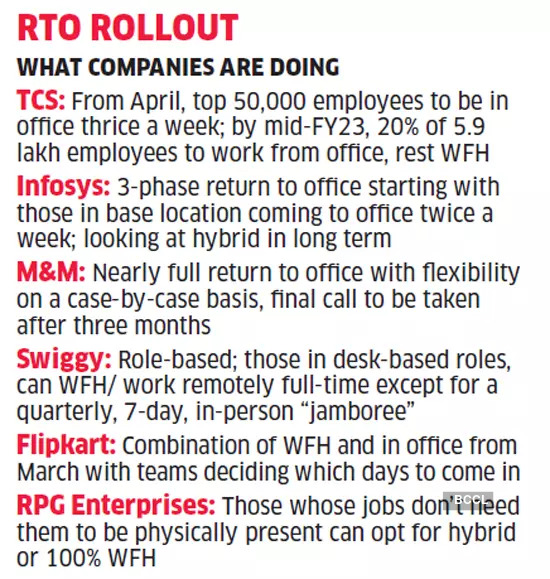
Companies large and small are in experiment mode. Some have set organisation-wide mandates to come in two or three days a week, while others are letting teams and managers thrash out the details. “Except those who need to be physically present like shop floor employees, all others are working hybrid or are on 100% WFH, if their role allows it,” says S Venkatesh, group president-HR, RPG Enterprises. FMCG major Marico has rolled out a hybrid work model which, according to CHRO Amit Prakash, “allows our members to shape their work around their lives. We have also outlined a case-by-case location flexibility option for remote work”.
IT behemoths Infosys and TCS are looking at continuing with the hybrid model. Accenture is setting up a presence in new locations like Jaipur and Coimbatore and has not set a universal date for employees to return to office. “When it comes to the future of work, we believe there is no one size fits all and our approach to how, when and where we work will vary by business, team and the type of work we do,” says Lakshmi C, MD and lead-HR, Accenture in India.
Food delivery unicorn Swiggy’s employee survey revealed that over 80% employees would like the flexibility of WFH. “One thing was clear: if we could trust employees for the last two years, why not continue that and make it flexible for them?” says Girish Menon, head-HR, Swiggy. Accordingly, employees have been put in role-based buckets, with those who work from a desk having the option to work from anywhere, provided they turn up every quarter for a 7-day, in-person “jamboree”. Ecommerce major Flipkart, which reopened its corporate office in phases, has adopted a hybrid model with teams having the discretion to decide details. “This model is a combination of employees working remotely and from the office on different days of the week, allowing teams to decide the days that work best for them,” says Chief People Officer Krishna Raghavan.
Naushad Forbes, cofounder of Forbes Marshall, was surprised to find employees coming to office most days when they piloted a mandatory one day a week in office. “I feel giving flexibility makes employees more productive,” he says. Pune-based engineering firm Thermax has adopted a role-based, hybrid work model. “We are not allowing permanent WFH as company culture gets impacted but we are also not mandating how many days employees spend in office as it will depend on the nature of work and what needs to be delivered. So our focus is on measuring outcomes instead of time in office,” says HR chief Jasmeet Bhatia, adding that not having a hybrid work environment is now considered outdated. At the Hyderabad office of US firm Solenis, employees come in two days a week, to be ramped up to three next month. “Employees don’t like perks being taken away. We have clarity that this model works so I don’t think we will go back to five days in office,” says vice-president Hitesh Chelawat.
And employees appreciate having autonomy and flexibility. Her firm’s hybrid work option allows 39-year-old Pali Tripathi, VP, fleet management solutions at RPG who became a mother recently, to work from home when she’s not out in the field. “Earlier, if we were not out meeting clients, we had to be in office. That’s no longer the case.” For newly-wed Pratik Singh, head, modern trade operations at Marico, the option to work remotely meant he could be in Hyderabad, his wife’s base, instead of having to look at relocation options. “It’s helped me have a healthy work-life balance without having to worry about career progression,” he says.
But these options are not across the board. All employees at Mahindra & Mahindra are back in office from April 1 with “flexibility being provided where needed” says group HR president Ruzbeh Irani. The policy, he says, will be reviewed in three months. On Thursday, chairman Anand Mahindra tweeted a video of employees back in office, adding, “Screens are no substitute for a warm personal hello.”
In sectors bled dry by a talent war, recruitment experts say remote and WFH options might well seal a hiring deal. Swiggy’s Menon affirms that the company’s policy is helping attract the category of talent that is interested in the brand and company, but less so in relocating.
“There’s a senior hire we are trying to get on board, who did not want to move to Bengaluru from Gurgaon. But once they read our work mandate, they became keen because now they know they need to come here only once a quarter,” he says.
Conversely, the lack of flexibility might drive out employees, who may initially toe the RTO full-time mandate but will leave as soon as they find a better option. A mid-management executive at a Mumbai-based conglomerate, for one, is fed up with the hassle of the daily commute his RTO involves. “I’ve applied for jobs at multiple firms,” he says, on the condition of anonymity.
As the RTO experiment rolls on, there will be new learnings. For one, companies will need to figure out how to maintain equity and fairness. “Those whose roles do not allow WFH might need to be compensated in some other way, not necessarily monetarily,” says IIM-B’s Dutta. There will also be the challenge of proximity bias. “A section of the workforce will come to office to show they are good organisational citizens, which might create pressure on others to follow suit.”
For now, flexibility is the key word. “I like hanging out with people and there’s a lot of learning that happens in person. But some people don’t, and that’s fine. It has nothing to do with productivity,” says Ajinkya Kulkarni, cofounder of Wint Wealth. The early-stage startup’s largely young 70-strong workforce can come to office or not, depending on their job profile but Kulkarni has noticed that people have been coming in voluntarily. “I think people are bored. And office main AC hota hai (office has AC)!”he chuckles. Kulkarni adds that the company is trying to keep things as flexible as possible. “Define targets, and as long as the work gets done, there is no need to look over anyone’s shoulder.”
As a nearly two-year, unprecedented WFH experiment comes to an end, questions abound. Some are existential, like what is the very point of an office if you can work equally efficiently from anywhere? Others less so, like what will my manager think if I come in once a week and my teammate thrice? Ironically, the one concern that’s not top-of-mind? “No one’s talking about Covid or health and safety. People assume the pandemic is over,” laughs 121help’s Gangrade.
The Gandhi family on Sunday shared election strategist Prashant Kishor’s presentation on the 2024 Lok Sabha elections with some senior Congress leaders, the latest indication that Gandhi and Kishor are likely to work together to formulate and implement the party’s general election strategy. are interested.
There are indications that Kishor is also keen to join the party and the leadership is ready for it.
The AICC said it would take a decision on Kishor’s proposals and wishes in a week, but there is a feeling in Congress circles that the meeting at 10 Janpath was a way for the Gandhi family to fulfill their wish through collective decision-making motions. .
Kishor’s presentation emphasized the need for the Congress to focus on less than 400 seats in the 2024 Lok Sabha elections, through single runs in friendless areas and alliances in states with potential allies, it is learned.
The 10 Janpath meeting also discussed the upcoming ‘chintan camp’ of Congress leaders, perhaps in Rajasthan, to discuss ways to revive the party. It is learned that the schedule of the camp will be finalized in the Congress Working Committee meeting to be held later this week.
Kishor is reportedly also conveying his vision to the Gandhi family on the upcoming Gujarat Assembly elections, including the benefits Congress will get by accepting socially influential industrialist Naresh Patel.
After the meeting, AICC general secretary (organisation) KC Venugopal told reporters, “Kishore has given a detailed presentation on the election strategy for 2024 to the Congress chief. The plan presented by him will be looked at by a group set up by Sonia Gandhi. The group will submit the report within a week for decision.
Asked whether Kishor would join the Congress, Venugopal said, “Every detail will be communicated within a week.”
Congress leaders who attended the meeting called by Sonia Gandhi included Rahul Gandhi, Priyanka Vadra, Venugopal, AK Antony, Digvijay Singh, Ambika Soni, Mallikarjun Kharge and Ajay Maken. The fact that the Gandhi family reached out to Kishor – after their attempt to join the Congress last year – is being seen as an advertisement of the Congress leadership’s desperation for outside help, especially as the party lost all five fell. Recent state elections.
Months away from the assembly elections, Prime Minister Narendra Modi will be on a three-day visit to Gujarat from April 18, during which he will lay the foundation stone of the WHO Global Center for Traditional Medicine in Jamnagar and a greenfield dairy complex in Banaskantha.
Modi will launch several development projects during the visit and participate in a program for tribal welfare in Dahod.
On 19 April, the Prime Minister will lay the foundation stone of the WHO Global Center for Traditional Medicine (GCTM) in Jamnagar in the presence of Mauritius Prime Minister Pravind Kumar Jugnauth and World Health Organization Director General Dr. Tedros Ghebreyesus. WHO). GCTM will be the first and only global outpost center for traditional medicine worldwide.
The Prime Minister will dedicate to the nation a new dairy complex and potato processing plant at Deodar in Banaskantha district, which has been built at a cost of over Rs 600 crore.
Modi will also inaugurate Banas Community Radio Station.
Modi will dedicate to the nation the expanded facilities for the production of cheese products and whey powder at the Banas Dairy Plant in Palanpur. Also, the Prime Minister will dedicate to the nation the organic fertilizer and biogas plant set up in Dama, Gujarat. He will also lay the foundation stone of four 100-tonne capacity Gobar Gas Plants to be set up at Khimna, Ratanpura-Bhildi, Radhanpur and Thawar.
Soon after his arrival on Monday, the PM will visit the Command and Control Center for Schools in Gandhinagar, which collects over 500 crore data sets annually and uses big data analytics, artificial intelligence and machine learning to enhance overall learning outcomes. Makes meaningful analysis of them using learning. for students.
Other functions include the inauguration of the three-day Global AYUSH Investment and Innovation Summit. Modi will attend the Adijati Maha Sammelan in Dahod on April 20, where he will inaugurate and lay the foundation stones for various development projects worth about Rs 22,000 crore.
The Prime Minister will inaugurate projects worth over Rs 1400 crore. He will inaugurate the Dahod District Southern Region Regional Water Supply Scheme, which has been built on the Narmada river basin at a cost of about Rs.840 crore.
The Prime Minister will also lay the foundation stone for manufacturing of 9000 HP electric locomotives at the production unit in Dahod. The cost of this project is around Rs 20,000 crore.
After completing a month in power on Saturday, the newly-elected AAP government in Punjab fulfilled its first election promise of providing 300 units of free electricity every month to every household in the state from July 1.
The Chief Minister of Punjab said that SC, Backward Caste, BPL families and freedom fighters are currently getting 200 units free every month, now they will get 300 units of electricity every month, if their consumption is 600 units in two months. more than that, they will be charged only for more units.
The Chief Minister said that if the consumption of electricity in other households exceeds 600 units in two months, the consumer will have to pay for the entire electricity usage. He said that there would be no increase in electricity rates for industrial and commercial consumers, while free electricity to the farming community would continue.
The move comes after inputs from cash-strapped Punjab State Power Corporation Ltd (PSPCL) that it would be difficult to provide free electricity in the summer months. As first reported by ET in its April 14 edition, the state is grappling with a shortage of coal to keep its thermal power plants running and is barely able to meet the current demand. With the onset of paddy sowing season, the demand for electricity will increase further. The PSPCL had told top AAP officials that providing free power at this time would lead to indiscriminate use of electricity and demand could pick up in the crucial summer months.
AAP Convenor and Delhi Chief Minister Arvind Kejriwal welcomed the move and said, “AAP does what it says and does not make false promises like other parties. An honest and patriotic government with clear intentions has come to Punjab. We We will not allow shortage of money gets in the way of progress.”
Meanwhile, Punjab Congress chief Amarinder Singh Raja Warring hit out at Chief Minister Bhagwant Mann and questioned the move, citing the conditions attached to it. “The proof of Halwa is in the food… The truth of your 300 units of free electricity will be tested in its details and conditions. Best wishes to PSPCL, who have to survive somehow,” tweeted.
According to the roster they drew up, J Vinayaka’s firm expected him to turn up at office only in September. But the 25-year-old Android developer had no intention of waiting another six months to visit the workplace he had joined — virtually — a year ago. So, soon after his office in a Bengaluru tech park reopened its doors in April, Vinayaka was there, walking through a colourful arch that said, “Happy 2B Home, Together as One”, past a recreational area with balloons and foosball tables and posing at a photo booth with the company logo, holding up a sign saying #BestDayEver.
As far as rolling out the red carpet for employees returning to office (RTO) goes, this might pale before what tech titans like Google in the Bay Area are planning (a private concert by pop star Lizzo awaits, reports The New York Times) but Vinayaka was bowled over. “They gave me all these welcome goodies — a company mug, sweets, cosmos plant seeds. It was awesome,” says the engineering graduate. But despite the warm fuzzy feeling of being in office and his genuine joy at meeting and chatting up colleagues from his and other teams, the Andhra native will be heading back to his hometown of Kurnool and intends to work from there till September. When remote work ends, he hopes he can work from home (WFH) at least some days of the week. “I like the hybrid model, where you can come if you want to and not if you don’t,” he says.
Having spent one day a week at the NCR office of his Big Four firm since mid-March, associate Varun Singh (name changed on request) is not convinced of the utility of even the occasional visit. “For my team, there is no point being in office as our work can be done from anywhere. We are going solely for the optics because the leadership wants to project a certain image,” says Singh, 27. To add to his chagrin, all the pandemic hiring has led to a space crunch. “I don’t have my own desk,” he says. But what about the lunch-time camaraderie and water-cooler chats some wax eloquent about? For Singh, it’s not worth the effort of the commute. “Nor am I getting as much work done as I do from home.”
With the Omicron surge ebbing and the bulk of their workforce vaccinated, many companies are asking staff to return to office. But who all should come, when, how often and how to convince employees of the point of it all is a minefield companies here, like their peers across the world, are gingerly navigating.
While the last two years have busted the myth that productivity hinges on being in office, the management view in many firms is that physical presence is important to foster innovation and company culture, improve collaboration and create a sense of belonging after two years of WFH. All this, they hope, may also stem attrition, which, in certain sectors like IT, are at record levels. Human resources teams are thus working overtime to make an event out of the “first day in office”, managers have been given budgets to take teams out for meals and your LinkedIn feed is probably awash with shiny, happy “#BackToOffice” videos. Some firms have also reached out to counsellors to ease employees’ anxieties over the return, says Meeta Gangrade, COO of employee assistance firm 121help.net.
But conversations with employees, employers and experts in recruitment and organisational behaviour reveal that the incentive people prize above all else is the flexibility to choose when to go to office, which the pandemic unexpectedly bestowed on many white-collar staff for the first time. Even those enthusiastic about going to office are less so about doing so every single working day. As Debolina Dutta, professor of practice — organisational behaviour & HRM, IIM-Bangalore, puts it, “Now that they (employees) have tasted blood, they don’t want to give that up.”
Some Tread Softly, Others Less So
This desire for flexibility is not confined to Gen Z. Mansee Singhal, rewards consulting leader at Mercer India, saw this when she visited the premises of a client. Pre-pandemic, it was a large campus abuzz with activity. But now, not more than 15% of the leadership was coming in since it was voluntary, the HR team told her. “If anything, the younger employees seem keener to come to office, having missed the office vibe and conversations with friends at work,” says Singhal.
Gayatri Sathiyan would agree. The 23-year-old is in the midst of relocating from Mumbai to Bengaluru for her new job though the company offers hybrid and remote work options. As someone who graduated amidst the pandemic, she has mostly worked remotely till now and is looking forward to making friends at work and interacting with managers and the leadership. “I’ll definitely miss the convenience of remote working, where you are your own master when it comes to your time. And many don’t want to get out of the comfort zone they’ve got into over the last two years. But a lot of my peers are also eager to build connections in the real world right now and work from an office or a co-working space,” says Sathiyan.
The sense of control that flexible working hours give is an attraction for employees, agrees social psychologist Anna Chandy. “But some have also said they would like to go back to the office so there’s no mixing of professional and personal lives,” she says. The boundary setting is a perk Hena Mehta, cofounder of fintech startup Basis, is appreciating anew on Day 2 of the company’s trial of being in office two days a week, despite the traffic being “a time sink!” “An office helps you separate work from your personal life — it helps you focus better. I’m seeing that particularly as a new mom,” she says, while also adding that WFH had eased her transition back to work from maternity leave.
According to recruitment site Indeed, employees across categories are comfortable with some degree of flexibility, with the portal seeing a 17.5% increase in searches for remote/flexible work in October-March. Also, a survey by Indeed revealed there is a gender skew, with more women seeking opportunities that offer hybrid and remote work. “There is a strong preference among women for jobs that offer flexibility, with 60% of women job seekers looking at remote and hybrid work options, while for men, it’s 20%,” says Sashi Kumar, head of sales, Indeed India.
Companies large and small are in experiment mode. Some have set organisation-wide mandates to come in two or three days a week, while others are letting teams and managers thrash out the details. “Except those who need to be physically present like shop floor employees, all others are working hybrid or are on 100% WFH, if their role allows it,” says S Venkatesh, group president-HR, RPG Enterprises. FMCG major Marico has rolled out a hybrid work model which, according to CHRO Amit Prakash, “allows our members to shape their work around their lives. We have also outlined a case-by-case location flexibility option for remote work”.
IT behemoths Infosys and TCS are looking at continuing with the hybrid model. Accenture is setting up a presence in new locations like Jaipur and Coimbatore and has not set a universal date for employees to return to office. “When it comes to the future of work, we believe there is no one size fits all and our approach to how, when and where we work will vary by business, team and the type of work we do,” says Lakshmi C, MD and lead-HR, Accenture in India.
Food delivery unicorn Swiggy’s employee survey revealed that over 80% employees would like the flexibility of WFH. “One thing was clear: if we could trust employees for the last two years, why not continue that and make it flexible for them?” says Girish Menon, head-HR, Swiggy. Accordingly, employees have been put in role-based buckets, with those who work from a desk having the option to work from anywhere, provided they turn up every quarter for a 7-day, in-person “jamboree”. Ecommerce major Flipkart, which reopened its corporate office in phases, has adopted a hybrid model with teams having the discretion to decide details. “This model is a combination of employees working remotely and from the office on different days of the week, allowing teams to decide the days that work best for them,” says Chief People Officer Krishna Raghavan.
Naushad Forbes, cofounder of Forbes Marshall, was surprised to find employees coming to office most days when they piloted a mandatory one day a week in office. “I feel giving flexibility makes employees more productive,” he says. Pune-based engineering firm Thermax has adopted a role-based, hybrid work model. “We are not allowing permanent WFH as company culture gets impacted but we are also not mandating how many days employees spend in office as it will depend on the nature of work and what needs to be delivered. So our focus is on measuring outcomes instead of time in office,” says HR chief Jasmeet Bhatia, adding that not having a hybrid work environment is now considered outdated. At the Hyderabad office of US firm Solenis, employees come in two days a week, to be ramped up to three next month. “Employees don’t like perks being taken away. We have clarity that this model works so I don’t think we will go back to five days in office,” says vice-president Hitesh Chelawat.
And employees appreciate having autonomy and flexibility. Her firm’s hybrid work option allows 39-year-old Pali Tripathi, VP, fleet management solutions at RPG who became a mother recently, to work from home when she’s not out in the field. “Earlier, if we were not out meeting clients, we had to be in office. That’s no longer the case.” For newly-wed Pratik Singh, head, modern trade operations at Marico, the option to work remotely meant he could be in Hyderabad, his wife’s base, instead of having to look at relocation options. “It’s helped me have a healthy work-life balance without having to worry about career progression,” he says.
But these options are not across the board. All employees at Mahindra & Mahindra are back in office from April 1 with “flexibility being provided where needed” says group HR president Ruzbeh Irani. The policy, he says, will be reviewed in three months. On Thursday, chairman Anand Mahindra tweeted a video of employees back in office, adding, “Screens are no substitute for a warm personal hello.”
In sectors bled dry by a talent war, recruitment experts say remote and WFH options might well seal a hiring deal. Swiggy’s Menon affirms that the company’s policy is helping attract the category of talent that is interested in the brand and company, but less so in relocating.
“There’s a senior hire we are trying to get on board, who did not want to move to Bengaluru from Gurgaon. But once they read our work mandate, they became keen because now they know they need to come here only once a quarter,” he says.
Conversely, the lack of flexibility might drive out employees, who may initially toe the RTO full-time mandate but will leave as soon as they find a better option. A mid-management executive at a Mumbai-based conglomerate, for one, is fed up with the hassle of the daily commute his RTO involves. “I’ve applied for jobs at multiple firms,” he says, on the condition of anonymity.
As the RTO experiment rolls on, there will be new learnings. For one, companies will need to figure out how to maintain equity and fairness. “Those whose roles do not allow WFH might need to be compensated in some other way, not necessarily monetarily,” says IIM-B’s Dutta. There will also be the challenge of proximity bias. “A section of the workforce will come to office to show they are good organisational citizens, which might create pressure on others to follow suit.”
For now, flexibility is the key word. “I like hanging out with people and there’s a lot of learning that happens in person. But some people don’t, and that’s fine. It has nothing to do with productivity,” says Ajinkya Kulkarni, cofounder of Wint Wealth. The early-stage startup’s largely young 70-strong workforce can come to office or not, depending on their job profile but Kulkarni has noticed that people have been coming in voluntarily. “I think people are bored. And office main AC hota hai (office has AC)!”he chuckles. Kulkarni adds that the company is trying to keep things as flexible as possible. “Define targets, and as long as the work gets done, there is no need to look over anyone’s shoulder.”
As a nearly two-year, unprecedented WFH experiment comes to an end, questions abound. Some are existential, like what is the very point of an office if you can work equally efficiently from anywhere? Others less so, like what will my manager think if I come in once a week and my teammate thrice? Ironically, the one concern that’s not top-of-mind? “No one’s talking about Covid or health and safety. People assume the pandemic is over,” laughs 121help’s Gangrade.