Tuesday, May 17, 2022

New unit under rail board to oversee Gati Shakti projects

A new branch has been constituted to oversee the implementation of projects under Gati Shakti Master Plan in Administrative Reforms of Railway Board.

According to officials with knowledge of the matter,

The Directorate of Power of Indian Railways will be headed by an officer of the grade of Additional Member. This will be the 25th Administrative Directorate of Indian Railways. Other directorates of the Indian Railways include Power, Tourism, Signaling and Telecommunications, Economics, Traffic, Planning and Infrastructure.

A senior Railway Ministry official said, “Implementation of Railways’ part of Gati Shakti program will be given priority by this directorate.”

The Rs 100 lakh crore Gati Shakti program was launched to reduce logistic costs and enhance the country’s export competitiveness.

Originally published at Pen 18

Apple News: Apple delays plan to have workers in office 3 days a week: report

Apple Inc. is indefinitely delaying a plan that would require employees to work from the office three days a week, Bloomberg News reported Tuesday, as COVID-19 cases continue to rise, Bloomberg News reported.

The iPhone maker did not immediately respond to a Reuters request for comment.

In March, Bloomberg cited an internal memo stating that after April 11, Apple employees would have to work from the office twice a week, and from May 23 at least three days a week. .

Find stories that interest you

Stay on top of technology and startup news that matters. Subscribe to our daily newsletter for the latest and must-read tech news, delivered straight to your inbox.
Originally published at Pen 18

Monday, May 16, 2022

West Bengal post-poll violence: CBI summons TMC MLA Paresh Pal

Kolkata: The Central Bureau of Investigation (CBI) on Wednesday summoned Trinamool’s Beleghata MLA Paresh Pal to the agency’s CGO campus office in connection with the alleged murder of BJP worker Abhijeet Sarkar in central Kolkata’s Narkeldanga in post-poll violence. of May 2021.

Biswajit Sarkar, elder brother of the deceased Abhijit Sarkar, and his mother had repeatedly claimed that MLA Paresh Pal’s aides were involved in the murder.

Biswajit Sarkar alleged, “I have protested in front of the CBI office that the agency should take action against Paresh Pal who was directly involved in my brother’s murder. Agency officials have called me to discuss the issue.”

Meanwhile, the CBI on Wednesday summoned Paresh Pal for questioning in the murder case.

BJP state president Sukanta Majumdar said, “Abhijit was a victim of post-poll violence and was brutally murdered by the Trinamool Congress. Action should be taken against all the accused.”

Abhijit Sarkar, the first victim of the post-election violence in Bengal, was brutally murdered in front of his house in May 2021. The family found the body on September 9, four months after his alleged murder after two post-mortems and DNA tests. were conducted as per the orders of the Calcutta High Court.

In July last year, a five-judge bench of the Calcutta High Court had ordered DNA test of Abhijit Sarkar, which was matched with samples collected from his brother Biswajit. Central Forensic Laboratory (

) was instructed to perform DNA matching.

On August 19, 2021, the Calcutta High Court ordered a CBI probe into all murder and rape allegations in connection with the post-election violence in Bengal. An SIT was constituted by a five-judge bench headed by Acting Chief Justice Rajesh Bindal, comprising three former IPS officers.

Originally published at Pen 18

The answer to stopping the coronavirus may be up the nose

The COVID-19 vaccines authorized for use today were developed at an unprecedented speed and exceeded expectations of how well they worked. Billions of people protected by him have survived severe symptoms, hospitalizations and death. These vaccines are a scientific breakthrough beyond measure.

And yet they can be even better.

The enemy has evolved, and the world needs the next generation of vaccines to respond. This includes vaccines that completely prevent coronavirus infection.

When the initial mRNA vaccines were first authorized in December 2020, the world was battling a different kind of pandemic. The dominant strain circulating had relatively little potential for spread between people. At the time, mRNA vaccines not only provided strong protection against serious illness and death, but they were also highly protective against infection and the spread of viruses.

But SARS-CoV-2 continued to mutate, and in doing so it has given rise to forms that are more infectious and able to shed around protective antibodies, leading to widespread infection, immunity from vaccines and prior infections. Despite the rising level of Thankfully, mRNA vaccines are still very effective in preventing hospitalizations and deaths, including the highly infectious Omikron variant, after the booster shot.

So, one might ask, why should we worry about infections if we can eliminate serious disease and fatality risk through a combination of existing vaccines and treatments?

Even mild infections can develop into protracted covids with people suffering from long-lasting, debilitating symptoms. The data also suggests that groups such as older adults who have been vaccinated but have not received their boosters may be at higher risk for the worst outcomes of COVID-19.

Regular infections can cause severe disruption to people’s lives, affecting their ability to work and keep their children in school. There is also no guarantee that people infected with Omicron will be safe from future infections.

One change that could make vaccines more effective is if they can stop the virus from getting in its way as soon as it enters the body. This can completely reduce the infection, as well as reduce the spread of the virus.

The currently available COVID-19 vaccines are injected into people’s arm muscles and are highly capable of combating the virus when people become infected. But they are not as successful in preventing people from getting infected in the beginning. To do this, you ideally want to prevent a virus from spreading in a place where people are infected: the nasal cavity.

That’s why groups of scientists, including me, are working on nasal covid vaccines. Ideally, a nasal vaccine can penetrate the mucus layer inside the nose and help the body make antibodies that take hold of the virus, not even giving it a chance to attach to people’s cells. Is. This type of immunity is known as sterilizing immunity.

By catching the virus at the site of infection, the antibodies induced by the nasal vaccine can help the body fight off the virus before it causes symptoms. Not only may nasal vaccines be better positioned to prevent infection, but they may also develop the same immune system defenses as other vaccines, and may be even stronger because this immune memory protects against virus entry. is on the portal. These vaccines can establish highly protective memory B cells, which make faster and better antibodies for future infections, and memory T cells, which help kill infected cells and support the production of antibodies.

These types of vaccines are traditionally considered more difficult to make. The mucus layer is a formidable barrier. The body does not produce a strong immune response even by spraying any conventional vaccines on the nose. The approved nasal vaccine for the flu, called FluMist, uses a weakened virus to get into cells in the nose and induce an immune system response. But this method is not safe for use in immunocompromised people.

The good news is that scientists like me believe we have found a way around this problem for SARS-CoV-2. We have shown in animal studies that we can nasally spray the virus’s so-called spike protein into a previously vaccinated host, reducing infections in the nose and lungs as well as providing protection against disease and death. . Combining this approach with efforts to develop a single vaccine for a wide range of coronaviruses could potentially protect people from future variants as well.

A big question is how long immunity from the nasal vaccine will last. So far in animal studies, antibodies and memory immune cells in the nose persist for months. Should this immunity wanes over time, like other vaccines, using nasal sprays as boosters – potentially over the counter – every four to six months may make the most sense for this pandemic.

This presents the same challenges as other boosters, where the uptake can be very high, especially for high-risk groups. It’s important to encourage people to get their boosters. But the barrier to a nasal spray booster may be less for many people than a needle shot.

The world desperately needs a vaccine strategy

Guard outside the gate to prevent viral invaders from infecting us. There are several other nasal vaccines in various stages of clinical trials. And whatever success we have achieved in developing a nasal vaccine for COVID-19 will not be limited to this one virus. Nasal spray vaccine strategies can also be applied to other respiratory pathogens.

While there are some remaining hurdles, the potential immunological and public health benefits of nasal spray vaccines deserve attention now and for years to come.

Originally published at Pen 18

Musk: Elon Musk versus Parag Agrawal battle continues on Twitter spam account issue

Mumbai: Twitter CEO Parag Agarwal spoke about spam, bots and platform manipulation in a series of tweets. He shared a blog post from 2020 –
‘Bot or not? Facts about platform manipulation on Twitter.’

Agarwal clarified what exactly these terms are and how the company deals with them. He added that social media platforms are ‘encouraged to detect and remove spam as much as possible.’

In addition, the chief executive also said that Twitter suspends over half a million spam accounts every day even before regular users notice the platform. “If we can’t pass the human verification challenges (captcha, phone verification, etc), we also lock millions of accounts every week, which we suspect may be spam,” said Agarwal. Huh.”

“Our team constantly updates our systems and rules to remove as much spam as possible, without inadvertently suspending real people or adding unnecessary friction to real people when using Twitter: also doesn’t want to solve the captcha every time twitter is used.” said.

Aggarwal further explained, FirstnameBunchOfNumbers may look like a bot or spam with no profile picture and weird tweets, but behind the scenes, several indicators show that it is a real person.

Find stories that interest you

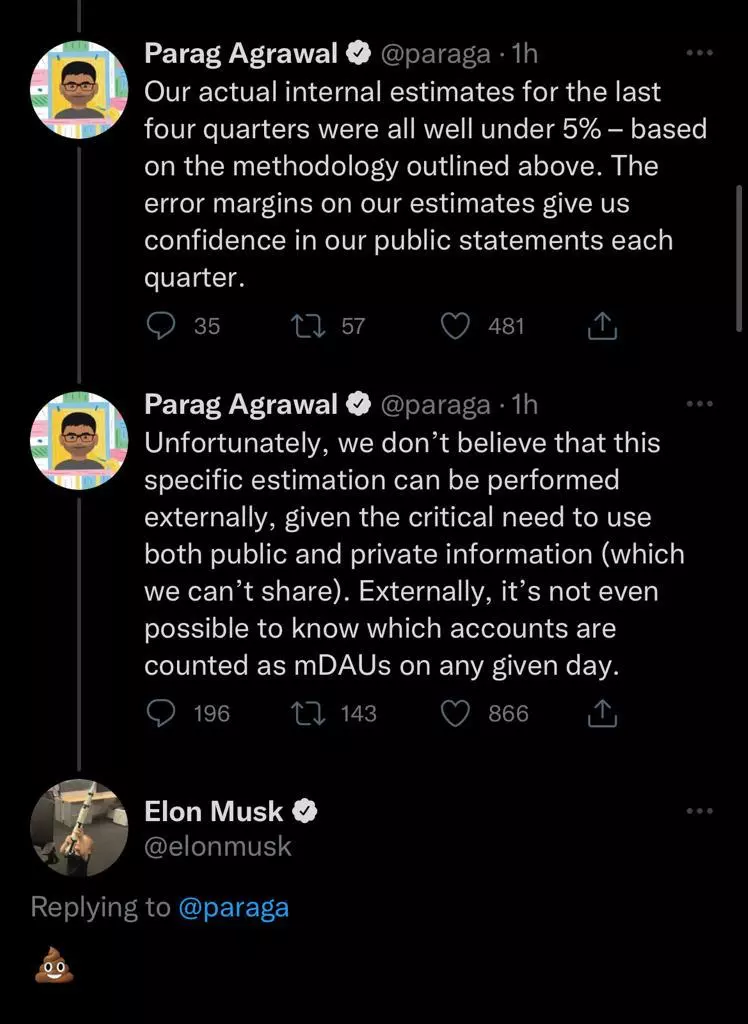
“Unfortunately, we do not believe this specific inference can be made externally, given the critical need to use both public and private information (which we cannot share). Externally, knowing this Also not possible which accounts count as mDAUs on any given day,” he tweeted, to which Tesla chief Elon Musk responded with an emoticon.

Kasturi vs AgarwalETtech

Musk replied “Have you tried just calling them?” When Agarwal tweeted that the Twitter rules define spam and platform manipulation, and use both public and private data to make a determination on each account.

“Beneath this high level detail are a lot of details that are very important. We shared an overview of the assessment process with Elon a week ago and look forward to continuing conversations with him and all of you,” Agarwal tweeted. Did.

It comes after Musk, who has made fake Twitter accounts and spambots a central theme of his acquisition plan, said he would “beat spam bots or die trying” if it bought the social-media platform. .

Elon Musk also tweeted on Saturday that Twitter Inc’s legal team has accused him of violating a non-disclosure agreement by disclosing that the sample size for the social media platform’s checks on automated users was 100.

Stay on top of technology and startup news that matters. Subscribe to our daily newsletter for the latest and must-read tech news, delivered straight to your inbox.

Originally published at Pen 18

How often can you be infected with the coronavirus?

A virus that shows no signs of disappearing, variants that specialize in bolstering the body’s defenses and dodging waves of infection twice, perhaps three times a year – this could be the future of COVID-19, some scientists now afraid.

The central problem is that the coronavirus has become more efficient at re-infecting people. Already, those infected with the first Omicron version are reporting a second infection with the newer versions of the version – BA.2 or BA2.12.1 in the United States, or BA.4 and BA.5 in South Africa. .

The researchers interviewed said that those people may also have a third or fourth infection within this year. And a small fraction may have symptoms that persist for months or even years, a condition known as protracted COVID.

“I feel like this is going to be a long-term pattern,” said Juliet Pulliam, an epidemiologist at Stellenbosch University in South Africa.

“The virus will continue to evolve,” she said. “And probably a lot of people are going to have many, many re-infections in their entire lives.”

It is difficult to measure how often people are reinfected, partly because many infections are no longer being reported. Pulliam and his colleagues have gathered enough data in South Africa to say that the rate is higher with Omicron than with previous variants.

“Probably many people are going to have many, many re-infections in their entire lives”

— Juliet Pulliam, epidemiologist

This should not have happened. Earlier in the pandemic, experts thought that immunity from vaccination or previous infection would prevent re-infection.

The Omicron version dashed those hopes. Unlike previous forms, Omicron and many of its descendants have evolved to have partially dodge immunity. This leaves everyone – even those who have been vaccinated multiple times – vulnerable to multiple infections.

“If we manage it the way that we manage it now, most people will get infected with it at least twice a year,” said Kristian Andersen, a virologist at the Scripps Research Institute in San Diego. “I’d be very surprised if that’s not how it’s going to play out.”

The new variants have not changed the fundamental usefulness of COVID vaccines. Most people who have received three or just two doses will not be so ill that they need medical care if they test positive for the coronavirus. And the booster dose, as in the previous bout with the virus, reduces the chance of re-infection – but not by much.

At the start of the pandemic, many experts based their expectations of the coronavirus on influenza, the viral enemy most familiar to them. He predicted that, as with the flu, there could be a major outbreak each year, most likely in the fall. The way to reduce its spread would be to vaccinate people before it arrives.

Instead, the coronavirus is behaving like its four closely related cousins, which cause colds throughout the year. “We looked at people with multiple infections within a year,” said Jeffrey Shaman, an epidemiologist at Columbia University in New York who studies common-cold coronaviruses.

If reinfection becomes the norm, the coronavirus “is not going to be just once a year this winter,” he said, “and it’s not going to be a mild nuisance in terms of the amount of morbidity and mortality it causes. is.”

Re-transitions occurred with earlier variants, including the Delta, but were relatively few. But in September, the pace of re-infection in South Africa seemed to be accelerating and was significantly higher until November, when the Omicron variant was identified, Pulliam said.

The number of re-infections reported in South Africa, as in the United States, may seem like a big change, as so many people have been immunized or infected at least once by now.

“This notion extends to what is actually going on biologically,” Pulliam said. “It’s just that there are more people who are eligible for re-infection.”

The Omicron version was so different from Delta, and Delta from earlier versions of the virus, that some re-infection was to be expected. But now, Omicron is developing new forms that penetrate immune defenses with relatively few changes to its genetic code.

“It’s actually a bit of a surprise to me,” said Alex Sigal, a virologist at the Africa Health Research Institute. “I thought we’d need a kind of new version to survive this. But really, it sounds like you’re not.”

An infection with Omicron produces a weakened immune response, which tends to subside more quickly than with previous forms of infection. Although the newer versions of the variant are closely related, they differ enough from the point of view of immunity that infection with one does not leave much protection against the others – and certainly not after three or four months.

Still, the good news is that most people who are reinfected with newer versions of Omicron will not become seriously ill. At least for the time being, the virus hasn’t hit the immune system in a way that can completely overcome it.

“It’s probably as good as it gets for now,” Siegel said. “The bigger danger may come when the version will be completely different.”

Still, each infection can bring with it the possibility of a prolonged COVID, constellation of symptoms that can last for months or even years. It is too early to know how often an Omicron infection causes long-term COVID, especially in people who have been vaccinated.

To keep up with the evolving virus, other experts said, COVID vaccines must be updated more quickly, even faster than the flu vaccine each year. He said that even an imperfect match with a new form of coronavirus would still broaden immunity and provide some protection.

“Every time we think we’ve been through it, every time we think we have the upper hand, the virus pulls a trick on us,” Anderson said. “The way to get it under control is not to be like, ‘Let’s get infected a few times a year and then hope for the best.

Originally published at Pen 18

Nora Fatehi Raises Temperature in Her Sizzling Black Attire Fans Say You Are on Fire – Pen 18

Nora Fatehi Hot Black Look: bollywood actor and dancer Nora Fatehi Fashion defies stereotypes. The dancer, who is also a judge on the reality television show Dance Deewane Juniors along with Neetu Kapoor and Marzi Pestonji, often turns heads with her sexy outfits. Nora Fatehi never fails to impress, whether she is rocking an ethnic look or going bold in her westerns. She has once again rocked the internet with her stunning outfit by Mulger.Also Read – Nora Fatehi Does Color Blocking Right in a 79K Crop Top and Thigh-Slit Skirt for Dance Deewane Juniors

The Dilbar girl of Bollywood, who mesmerized us not only with her incredible dance moves but also with her hot and stylish pictures, can be seen posing in reflective piping, black lycra and sheer tulle paired with long net pants. Nora completed her look with a statement making black hat. The Bollywood dancer looked ravishing in her latest sexy avatar. Sharing the picture on her Instagram, Nora captioned her picture as, “Next…” Also Read – Dance Deewane Juniors: Nora Fatehi looked beautiful in a green outfit on the dance reality show!

Check out Nora Fatehi’s Instagram post here:

Also read- Nora Fatehi wore a shimmery embellished white see-through gown worth Rs 2 lakh, stuns the internet with sizzling hot pictures

Nora’s latest picture has grabbed the attention of her fans and followers. He graced her comment section with a heart-eye and fire emoji. One of the users called her Blackberry because of her black sheer dress. Another user said, “This dress is made just for you, you look stunning in this dress.” Her fans also said that she set the internet on fire with her latest picture and we couldn’t agree more!

What is the cost of Nora Fatehi outfit?

Do you like Nora’s outfit? You can also add it to your wardrobe. Her sexy outfit is a blend of eco sport Lycra and sheer tulle with reflective piping from Mugler brand. The sports bra costs 555 euros i.e. Rs 44,631.23.

What do you think about Nora Fatehi’s look? let us know!

$(document).ready(function(){ $('#commentbtn').on("click",function(){ (function(d, s, id) { var js, fjs = d.getElementsByTagName(s)[0]; if (d.getElementById(id)) return; js = d.createElement(s); js.id = id; js.src = "//connect.facebook.net/en_US/all.js#xfbml=1&appId=178196885542208"; fjs.parentNode.insertBefore(js, fjs); }(document, 'script', 'facebook-jssdk'));

$(".cmntbox").toggle(); }); });

Originally published at Pen 18

new zealand: Rain interrupts play in second ODI against New Zealand with India on 22-0 after 4.5 overs

India were 22 for no loss in 4.5 overs against New Zealand when rain stopped play in the second one-day international at Seddon Park here on...