Monday, August 15, 2022

Urban Decay Goes Beyond Green With She-Hulk Makeup Collection Release – WWD – Pen 18

Urban Decay has teamed up with Marvel Studios for yet another makeup collection.

The collaboration is inspired by the upcoming Disney+ show “She-Hulk: Attorney at Law,” featuring two new eye shadow palettes. The first is a mega-sized palette with 13 new supersaturated shades while the second is a tiny one with six shades.

The larger palette, called the She-Hulk Eyeshadow Palette, includes shades inspired by the show, with silky mattes, intense shine, and the iconic Hulk Green shade with a big transformative in between. The colors are meant to represent the main character’s attempt to balance his career as a lawyer and his new Hulk powers.

Take a closer look at the oversized eyeshadow palette from the Urban Decay x She-Hulk collection.

Courtesy of Urban Decay

The mini, travel-friendly palette features six shades that range from warm neutrals to simple shimmers.

The large palette costs $45 while the mini palette costs $30. Both will launch exclusively on Urban Decay’s official e-commerce site from August 24.

Urban Decay x She-Hulk Makeup Collection

Take a look at the Mini Eyeshadow Palette from the Urban Decay x She-Hulk Collection.

Courtesy of Urban Decay

Last fall, the beauty brand and Marvel teamed up to create a collection based on the studio’s film “Eternal,” starring Gemma Chan, Angelina Jolie, Richard Madden, Kumail Nanjiani, and others.

“She-Hulk: Attorney at Law” follows the story of Jennifer Walters, a lawyer who specializes in superhuman cases as she becomes She-Hulk, the female counterpart of the Incredible Hulk.

New TV August: She Hulk: Attorney at Law

A still from “She-Hulk: Attorney at Law” on Disney+.

Disney+. Courtesy

The series, which premieres August 18 on Disney+, stars Tatiana Maslany, starring Jameela Jamil, Ginger Gonzaga, Renée Ellis Goldsberry, Tim Roth, Mark Ruffalo, Benedict Wong and Charlie Cox in supporting roles.

Ruffalo, Wong and Cox will reprise their Marvel Cinematic Universe roles on the show, playing Bruce Banner or the Hulk, Wong (The Sorcerer Supreme) and Matt Murdock or Daredevil.

“She-Hulk: Attorney at Law” is part of Phase Four of the Marvel Cinematic Universe and consists of nine episodes.

Originally published at Pen 18

Sunday, August 14, 2022

Details, Brand Growth Stats and More – WWD – Pen 18

The Sporty & Rich category continues its impressive growth with expansion.

The four-year-old loungewear brand founded by Emily Oberg is launching its first swimwear collection on Monday, marking the brand’s latest category expansion. Sporty & Rich first forayed into swimwear last year in association with Solid & Striped.

The first Sporty & Rich swimwear collection includes bikinis and one-piece bathing suits in a brown, off-white and green color palette. Both styles include a high-cut bottom and strappy top.

The collection also features pieces such as T-shirts, shorts, button-up shirts, crewnecks and hats to match the swimwear.

A campaign image from the Sporty and Rich swimwear collection.

Courtesy of Sporty and Rich

Oberg said of her design process, “I make things I want to wear and I think I might not be getting, or things I’ve got, but I want to make better.” “Everything is too simple. I would never do a fashion piece—nothing too risky or too inventive. It’s a lot of uniform dressing and just so many basics and staples that I would like to have in my wardrobe right now and now.” Even after 10 years.

According to the company, the sporty and rich swimwear collection comes as the brand continues its growth trajectory. Sporty & Rich said it saw sales rise from $400,000 in 2019 to $4 million in 2020, thanks to a boom in loungewear as people stay home and look for casual clothing options during the COVID-19 pandemic. happened because of The following year, the brand posted sales of $12 million and is projected to have $20 million to $24 million in sales this year.

“People have always been wearing [loungewear] before it became popular [during the pandemic],” Oberg said. “I don’t think sweatsuits and casual clothes will ever be worn. There’s a time and a place for this.”

While Oberg experienced unprecedented growth amid the pandemic, she said the fast pace almost destroyed her brand as it struggled to keep up with demand.

“Sometimes growth can kill a brand,” she said. “It happens often and before COVID[-19], we were very young. Our sales were nothing special, but then with COVID[-19] It expanded and development almost killed us. I would say we were on the verge of it, but we quickly figured it out.

Oberg maintained its business by developing its team and establishing systems to operate more smoothly, such as creating a customer service team and utilizing a new logistics center and factory.

Sporty and rich swimwear collection

A campaign image from the Sporty and Rich swimwear collection.

Courtesy of Sporty and Rich

These changes also came at a time of controversy between the founder and his label. The brand initially came under fire at the start of the pandemic for an insensitive Instagram post that compared the cost of fast food items to “real food” — things like an apple, instant oatmeal or bag of lettuce — With the caption, “You don’t need to be rich to be healthy” many criticized the brand, which has since deleted the post for the elite.

Oberg was also called out for allegedly making insensitive remarks and laughing at racially insensitive jokes on the podcast.

“I mean, I’m a female, Asian minority founder, so it’s not like I’ve never faced discrimination myself, so I’m very aware and dealt with these things already,” Oberg said. said in response. Conflict. “It’s not that I need to intentionally not be a racist person because I think that’s embedded in me and that’s how I was born. I feel like some of these other founders should go out of their way to read all these books.” Had to read how not to be racist, but for me, it’s never been an issue of who I am. Being more sensitive to the fact that not everyone has access to healthy food – which is one of the main points. Had one, and exercising or even taking supplements – I would say [I was] Not secret, but I guess I wasn’t being sensitive enough to people. Especially with wellness sites – writing all this health advice and not realizing that many people can’t even do what we’re told. So I think in that sense, content is more for everyone now, where it’s like, we have a lot of articles on how to stay healthy for essentially minimal resources, and these are things you can do with zero budget. can be done. And in terms of the brand in general, I’d say it’s pretty accessible, the price point being on the lower end compared to other streetwear brands. ,

Sporty & Rich sells t-shirts for $60, sweatshirts for between $150 and $185, and sports bras for $85.

Oberg explained that hiring more staff members and implementing new systems in the years following the controversy helped correct these missteps.

Moving forward, Oberg is releasing a Sporty & Rich coffee book and is eyeing a storefront.

“It is important for people to have a real life point of connection for discovering the brand world and lifestyle,” she said. “There is only so much you can connect with people online. Online is still going to be an important focus, but I think it would be nice to create a bigger and stronger sense of community, so a store helps with that.

Originally published at Pen 18

FIFA: ‘Don’t pay too much attention’: Sunil Chhetri tells players on FIFA ban threat

Veteran striker Sunil Chhetri on Sunday advised fellow players to continue to give their best on the pitch and not worry about FIFA’s suspension threat on Indian football.

Earlier this month, world football governing body FIFA threatened to suspend the AIFF and take away its rights to host the Women’s Under-17 World Cup in October due to “influence” of third parties, the Supreme Court warned. Coming a few days after the instruction. To conduct national federation elections.

However, the Supreme Court-appointed Committee of Administrators (CoA) has started the electoral process. The elections are to be held on August 28.

“I have spoken to the boys and my advice is not to pay too much attention to it as it is beyond your control,” Chhetri said during a virtual media interaction organized by his club Bengaluru FC in preparation for the new season. ,

“The people involved are doing their best to ensure that we come up with the best possible results.

He said, ‘Everyone is working hard for this. As far as the players are concerned, we are going to make sure that we do our job properly.

“We have to make sure that you improve yourself as a player. Whenever you get an opportunity to represent your club or your country, do your best.

“All other verticals of AIFF are trying to do as fine a thing as possible to ensure that they come out with flying colours,” he added.

India is to host the FIFA Women’s U-17 World Cup from October 11-30 and the Union Cabinet last month approved signing of guarantees to host the women’s age group showpieces in Bhubaneswar, Goa and Mumbai.

The Durand Cup will kick off the season in Kolkata on 16 August and Bengaluru FC will take on Jamshedpur FC on the second day of the tournament.

Having won every major national title since the team came into existence in 2013, the Blues will be desperate to add the missing Durand Cup to their trophy cabinet.

For Chhetri too, it is “very, very special” as he hasn’t even won Asia’s oldest football competition, the 131st edition of which will be held this year.

“It’s very, very special. It’s one of the oldest tournaments that’s huge in itself. But more so for me. As a club we haven’t won and personally I haven’t won the Durand Cup Is.

“I have been lucky enough to win a lot of tournaments, almost all tournaments that can be held in India, and the Durand Cup is missing.

“So, that’s an added motivation for me. We will try our best as a club. Last year our young boys accounted for themselves well, we want to make it better.”

For the first time, all 11 Indian Super League (ISL) clubs will participate in the tournament.

Trophy-less for the past few seasons, BFC have made some interesting signings in former ATK Mohun Bagan shooters Roy Krishna, Xavi Hernandez, Probir Das and Sandesh Jhingan.

Chhetri’s pairing with Fijian star Roy Krishna may have become a topic of discussion, but India

Tried to play it down.

“I think the pair is over-hyped. It’s not Jodi, it’s just Roy. I’m happy with Roy. We’re just going to make sure this guy is happy because we know what he can give.” He has been excellent in training.

“He’s bothered us a lot over the years, so it’s a nice feeling to have him wear our jersey. We’re going to sit back to keep him happy and we all know what he can do on the pitch.

“He is doing his best to be a part of the team, making sure he talks to all the youngsters. He is very playful.

“With so much experience, he doesn’t shy away from expressing his opinion. He is making sure everyone around him is happy,” said Chhetri.

Chhetri will be reuniting with India teammate Sandesh Jhingan at the club as centre-back, five years after winning the Federation Cup with the team.

Terming it a “welcome addition”, Chhetri said: “I wish him all the best. I want to assure him that we are going to give him all the support he needs and also know that he is there for us.” Going to give everything that they have. Doing well.”

Originally published at Pen 18

Ian Chappell: Australian legend Ian Chappell calls time on his career inside the commentary box

A report in the Daily Mail on Sunday quoted the Sydney Morning Herald as saying that Australian cricket great Ian Chappell has officially given time to his more than four-decade-long commentary career.

The 75-Test legend, who ended his illustrious career with over 5,000 runs in the longest format, reportedly said that his decision to leave the broadcast box was tantamount to his career retirement call.

The cricket great began his stint inside the media box soon after retiring from international cricket, where he led Australia in 30 Tests.

“I remember the day when I knew I had enough cricket to play,” the 78-year-old, who worked with Channel 9 and ABC in 1980, told the Sydney Morning Herald. “I looked at the clock and it was half past five on game day and I thought, ‘S***, if you’re looking at the clock at that time, I’ve gotta go,'” Chappell was quoted as saying.

The veteran, who spent time on his international career after scoring 14 Test centuries in 1980, also said that he was nearly fired by media baron Kerry Packer in the midst of World Series cricket.

‘Kerry wanted to fire me a couple of times. He used to give crap about one-day cricket, because that was his kid… with Carey it was like a storm, you’ll blow it up until the next one comes,’ Chappell said.

Chappell said he enjoyed talking with the late Richie Benaud, the legendary cricketer, and added that while he did not predict the demise of Test cricket in his lifetime, he was not very optimistic about its future.

‘(Test cricket) will not die in my lifetime. But who will play it? That’s the big question,’ Chappelle told Channel 9.

Originally published at Pen 18

Hima Das: Nikhat Zareen gifts PM Modi boxing gloves, Hima Das gives traditional gamocha

Indian athletes expressed happiness at being felicitated by Prime Minister Narendra Modi for their outstanding performance in the Commonwealth Games, with Nikhat Zareen gifting him his boxing gloves and sprinter Hima Das with a traditional Assamese gamocha. Modi hosted the Indian contingent at his residence on Saturday to felicitate the players.

Indian athletes put up a sensational performance in Birmingham to win 61 medals including 22 Gold, 16 Silver and 23 Bronze.

Nikhat tweeted, “Honoured to gift Hon’ble PM @narendramodi sir the boxing gloves signed by all the boxers. Thank you for this wonderful opportunity. Had a great day with my fellow athletes who made the nation proud has done.”

The world championship gold medalist star boxer won the yellow metal in her weight category at the Games.

Hima wrote on her Twitter handle, “Excited to receive blessings from our Honorable Prime Minister – Shri @narendramodi ji on the basis of Commonwealth Games 2022. Wrapped with immense gratitude from all over Assam to present him with our traditional Gamcha. Good luck.”

Champion weightlifter Mirabai Chanu, who won the gold medal without breaking a sweat a year after her historic silver at the Tokyo Olympics, thanked the PM for his words of encouragement.

“Felt honored to meet and interact with Hon’ble Prime Minister Narendra Modi sir. Thank you very much for all your support and encouragement. Jai Hind,” Chanu said.

Appreciating the stellar performance of the Indian contingent, the Prime Minister said that the golden era of Indian sports was knocking at the door.

Shuttler Chirag Shetty wrote on the microblogging site, “Thank you sir for giving your valuable time and inviting us to your residence. It was always a pleasure to talk with you.”

His young badminton colleague Lakshya Sen, who won the men’s singles title in a spectacular fashion, also expressed his gratitude for being felicitated by the PM.

“A great day #gratitude to all the athletes. Thank you so much for appreciating our hard work and the words of encouragement. We are all so grateful for your support. Will continue to make our country proud. Jai Hind!” Sen tweeted.

Star Indian para table tennis player Bhavna Patel, who won a gold medal in the women’s singles category 3-5, described her interaction with Modi as inspiring.

“Meeting Hon’ble PM @narendramodi ji once again, interacting with him and seeking blessings was as inspiring and motivating as ever. His keen interest in our performances and detailed interactions is very gratifying!” Bhavina said.

After the felicitation program, the Prime Minister said, “CWG 2022 will always be remembered for its memorable performance and diversification in our quest for excellence.”

Originally published at Pen 18

Saturday, August 13, 2022

bayern: Bayern Munich and the myth of competition

It just ended like that. For a month or two, there was the slightest glimmer of hope for the clubs in the Bundesliga. He hadn’t felt it in a while. They didn’t want to admit to feeling it now, not in public: it was fragile, guilty, most likely, but it was hope nonetheless.

Robert Lewandowski was gone. Serge Gnabry, for a time, looked like he might follow. Thomas Muller and Manuel Neuer were another year older. For the first time in a decade, Bayern Munich didn’t seem weak – Bayern Munich never get weaker – but just a little less, just a little more human.

At Borussia Dortmund, at Bayer Leverkusen, at RB Leipzig, the idea would have been formed, unopposed and silent. What if Dortmund’s reinforcements worked? What if Florian Wirtz flourished? What if Christopher Nkunku was only just starting out? What if it was one of those years, in between, the marginal ones, when Bayern fade and another rise?

And then the cold reality infiltrated. Bayern’s first game of the season was at Eintracht Frankfurt: an intimidating stadium filled with rafters cheering on a team that had won the Europa League a few months earlier. This was not a soft start. Not for the first five minutes anyway.

Then Joshua Kimmich scored. Five minutes later, Benjamin Pavard did the same. Then, on his debut, Sadio Mane, and Jamal Musiala, and Gnabry himself, and now the Bundesliga season was exactly 43 minutes, and all hope was extinguished and all was answered. Just like that, for another year, it was over.

Hope is, of course, a little harder than that. No one, not even Bayern Munich, wins the championship in August. Its defeat to Eintracht was only one game away. Perhaps, Julian Nagelsmann’s strategy will go awry in the coming months. Perhaps Bayern’s squad will break into a full-scale rebellion. Perhaps it will suffer from an injury epidemic. Perhaps, as was outlined in this space last week, the World Cup will split the season into two halves, both surrounded by randomness.

Nevertheless, the impression left from that opening day was indelible. Lewandowski’s departure, and the lingering sense of generational change it has created at Bayern, have done nothing to change the power dynamics in the Bundesliga. Its championship fate seems predetermined, if not from the moment the season begins, then certainly from the 43rd minute.

Of course, this has come to be seen as a fatal flaw in German football. Bayern has the most fans, the most commercial influence and the most Champions League prize money, and therefore dominates what now surrounds the absolute. It has won every title for the last 10 years. Sometimes, there is a difference of 25 marks for the nearest contender. There is no drama. There is no doubt about it. Describing the Bundesliga as a competition at the top of the table doesn’t quite feel right.

Germany, at least, is not alone. In France, Paris Saint-Germain started their season with three runs in 38 minutes against Clermont and won 5–0. PSG have won eight of the last 10 available titles in France. Its budget, bloated with Qatari favors, has no ties to any of its rivals. The air is also inevitably thick in Ligue 1.

In theory, of course, this not only reflects badly on these two leagues, but also limits both their appeal and their ambition. Sports, we believe, require two things to fill stadiums, to attract the attention of drifting and distracted television viewers, to retain old fans and attract new ones.

They are related (and often confused) but different. One is what is commonly called competitive equilibrium: the idea that multiple entrants to a tournament can win it in the end. The second is known, academically, as the uncertainty outcome hypothesis: the belief that an individual sport within any given competition is attractive only when fans feel – or at least feel themselves. Can cheat – as if both sides stand a chance.

The best measure of how important these concepts are perceived by the league comes in the form of the Premier League’s deeply hubristic, though undeniably successful, marketing strategy.

In England, the top flight’s sense of self is inextricably linked to the idea that not only can any team beat any other team at any given time, but that it alone can compete with many challengers for the final crown. Claims people.

After all, Germany and France only have one. Spain has a smaller three: Real Madrid, Atlético Madrid, and Barcelona with no pieces sold to sign Marcos Alonso. Italy’s contenders could rise to four these days, but that’s only because Juventus very politely decided to spend three years in self-transplantation.

England, however, have no less than six, a full half-dozen teams that go into the season with a shot at winning the championship that is more than theoretical at least. The reality, of course, is considerably more complicated: not just because some of the six are more equal than others, but also because having a comparatively wider swath of contenders means less predictable seasons but more predictable games.

But truth, in this case, matters less than belief. The success of the Premier League is less, it is largely acknowledged, for the fact that it has fewer processions than all of its rival competitions. It follows, then, that the prospect of yet another season in which Bayern Munich and PSG are vying for their home crowns is a black mark against the league that houses them.

This, to most fans, sounds right. It just feels. Obviously it is a drawback from the start to know which team will emerge victorious. Like going to a movie with all the information that one lover lets the other drown even though there’s plenty of space on the raft, or that the guy is actually a ghost, there’s no point in staying until the end. There has to be a competitive balance. There should be uncertainty of the outcome. After all, that’s what we see.

Except that, as it happens, it doesn’t happen. A paper published in 2020 by researchers at the University of Liverpool – and drawing on a welcome addition of academic inquiry into sports fans’ motivations – found that there was no correlation between how uncertain the outcome of any given game was and how many people watched it. . The link, he wrote, was “decisively redundant”.

It’s not, it turns out, why most people watch sports, whether we want to admit it ourselves or not. According to the researchers, there was a correlation between the number of viewers and the quality of the player in the show. More importantly, however, was the name of the teams involved. The power of the brand, he wrote, was its tendency to “dominate any contribution to audience size”.

Those two findings suggest that, rather than undermine the Bundesliga’s appeal, Bayern’s win did the exact opposite. Here, after all, was a team with a well-known name and an established brand full of highly talented players. Looks like that’s what fans want.

It is this thinking that has convinced PSG to try to blind the rest of Ligue 1 and much of Europe with their sheer star power. This argument is regularly made by the Bundesliga to defend Bayern’s impregnable hegemony. Football’s dirty little secret is that it nurtures dominance, not balance; It craves diversity, but nothing pulls it off like dynasticism.

And yet, there is another finding in that 2020 report that deserves attention. “The match with the highest championship significance observed in our data set would be expected to attract 96% more total spectator size without any implications for the prizes awarded at the end of the season,” even if the teams involved were the same. , the researchers wrote.

In other words, what fans really want – more than the competitive balance, more than the uncertainty of the outcome, more than famous faces and powerful names – is at stake. They want, we want, risk as much as we can get: the game when it seems like everything is on the line. That’s what leagues sell. This is what attracts fans.

Ultimately neither Germany nor France can offer it. Given the distorting effects of Champions League revenue across the continent, season by season in the rest of Europe’s major leagues and some of its minor leagues is becoming increasingly rare.

But that’s what we want, more than anything. Watching Bayern and PSG ride rough on everyone provides a short-term hit, the fleeting satisfaction of awe but at the cost of greater rewards. Most likely, this season there will be no decider in the Bundesliga. There will be no final showdown. How can it happen, when everything is settled in 43 minutes?

difficult conversation

Without a doubt the most horrifying transfer of the summer was not the one in which a troupe of Europe’s biggest clubs searched for Erling Haaland, or Manchester United’s futile pursuit of Frankie de Jong, or even the heartbreak of Real Madrid. Tried, which was rejected by Kylian Mbappe. , Instead, Gonçalo Guedes aims to move from Valencia to the Wolves.

Every move, after all, would have been full of traps and traps and pitfalls. First, the agent who has a close relationship with Wolves’ owners, Jorge Mendes, will have to get in touch with the agent most aligned with Valencia’s owner, Jorge Mendes, to see if the player is interested in the move. keeps.

Next, those agents must reach out to the player’s agent – Jorge Mendes – to see if his client is interested in the move. Geddes must then contact Wolves’ manager, Bruno Ledge, to discuss his role in his new team, probably through Ledge’s agent: Jorge Mendes.

And in the end, politics may have dictated that Geddes express his desire to leave Valencia’s new coach, Gennaro Gattuso. Gattuso, undoubtedly, would have been furious. He tried to sign Guedes only last year, while Gattuso was (briefly) at Fiorentina. This was his chance to work with a player he clearly admires. We can only imagine that he must have expressed his disappointment at losing him to his agent in no uncertain terms. George Mendes.

This article is originally from . appeared in
new York Times,

Originally published at Pen 18

Beginning of the end of all-format cricketers?

The days of all-format cricketers are numbered. It is difficult to predict exactly when the last straw of the proverb will break the camel’s back. What can be said that this will happen as soon as possible.

Last month, when England’s Ben Stokes announced his retirement from one-day internationals, his message was clear and clear: “The three formats are just untenable… because of the schedule and what is expected of us (the players).”

New Zealand’s Trent Boult, the latest all-format player to join the growing list of players moving away from international cricket, didn’t say it outright but did highlight the need to spend more time with his wife and kids. “Family has always been the biggest motivator for me and I feel comfortable putting it first and preparing myself for life after cricket.”

Last December, South Africa’s Quinton de Kock also expressed a desire for more family time when he retired from Test cricket at the age of 29.

They have all been victims of the overly hectic schedule of cricket which keeps the players away from home for long hours and not enough free time.

Sample India’s whirlwind schedule since the 2022 Indian Premier League (IPL) final on May 29:

In just 72 days, the Indian cricket team has had 26 match days – that is, one match every third day.

Let’s expand it.

A typical year has 365 days, which are further divided into 52 weeks. Let’s say two vacation days per week, there are about 261 active days in a year (when a person is active for the purpose of doing his job). Then there are holidays and paid leaves. After subtracting these, an average person is likely to be active for about 220-30 days in a year.

Active days for office goers usually include a combination of reading, writing, planning, meetings, phone calls, and other non-physical tasks. An average office goer has to go through the most difficult form of physical labor traveling between home and office. What modern day international cricketers do with their bodies to prepare for their main job, i.e. playing matches, will make your jaw drop.

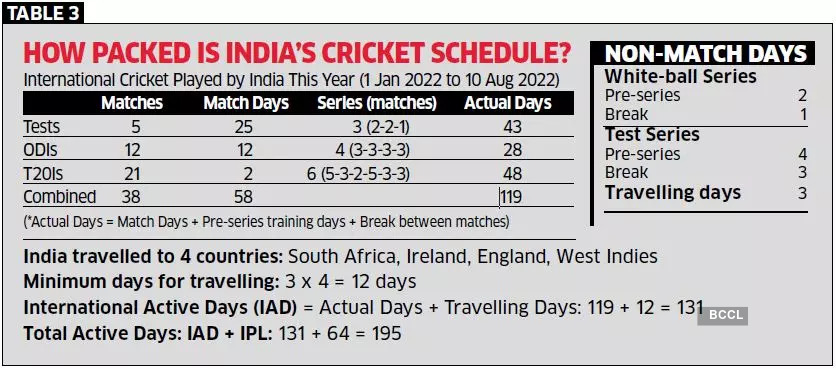
Indian cricket (don’t mistake it with Indian cricketers!) already has 195 ‘active days’, including 64 days of IPL, with only 224 days completed this year (from 1 January 2022 to 10 August 2022) .

A cricketer’s ‘active days’ can be divided into three parts:

  1. match day
  2. Training, rest and recovery days
  3. travel day

But before we go any further, let’s understand how we arrived at this number of 195 active days.

As, and if, you read further, you will realize that the said number is not accurate, certain things had to be assumed, such as the break between two matches, the training days before a series and the travel days. But you will realize that the exact number may not vary much. These approximate numbers were then added to the number of match days, which is also different from the number of matches. For example, a Test match is of five days duration. (But not all Test matches last long.)

The grind begins with the journey. For an overseas series, a team has to gather at one place before flying together and then spend at least a day at their hotel to get rid of jet lag. In total, players need three to four days to be ready to travel abroad and start training.

Any team would need at least two to four days of training to be match-ready. In case of Tests it can be higher as teams also play practice/tour matches. For calculation purposes, let’s give two days for white-ball matches and four days for red-ball cricket.

The third part is the break between matches. While a break may seem like a period of no activity, it is better than nothing. The process of recovery and preparation for the next game involves a lot of activities, sometimes as grueling as the match itself. On average, teams get at least one day’s break between two white-ball games. For Tests, it is at least three days.

For detailed calculations, see Table 3.

Table 3

No player, however, was active on all days – this is not humanly possible – either with an injury, coming to the rescue for rest or the board-mandated rest. But let’s imagine a cricketer plays all the matches and is active throughout the day, do you see him survive this endless marathon?

While this punitive program affects everyone, the most affected are players of all formats, especially fast bowlers (Boult) and multi-skilled cricketers such as all-rounders (Stokes) and wicketkeepers (de Kock). But Virat Kohli and David Warner are equally impressed by the intensity they display on the field.

The development of a third format, Twenty20, and its spread through franchise leagues have done two things: it has crowded the calendar and brought in never-before-seen money.

This packed cricket schedule is partly aided by the ICC’s push for a bigger event each year, but with a growing number of T20 leagues around the world, players spend some time without missing a series or two. There is no window for

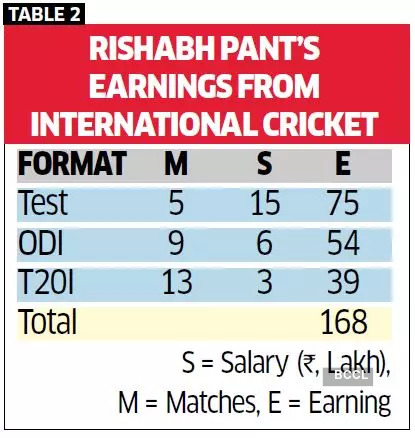
But no player can afford to be ignored in the T20 league. There is a lot of money available to make. This year Rishabh Pant earned 16 crores by playing 14 IPL matches. He has played 27 matches for India so far and has earned only Rs 1.68 crores. Even if you add the Rs 5 crore he gets through the central contract with BCCI, it doesn’t come close to his IPL earnings.

Table 2

Players are already grappling with the tough choices they will have to make to strike a balance where they can maximize their career earnings, make their country proud and have time to spend with their families. Leaving an international format can bring some balance out of that. For how long, that is a question for the future. Right now, players of all formats are at risk of serious burns.

Originally published at Pen 18

new zealand: Rain interrupts play in second ODI against New Zealand with India on 22-0 after 4.5 overs

India were 22 for no loss in 4.5 overs against New Zealand when rain stopped play in the second one-day international at Seddon Park here on...